
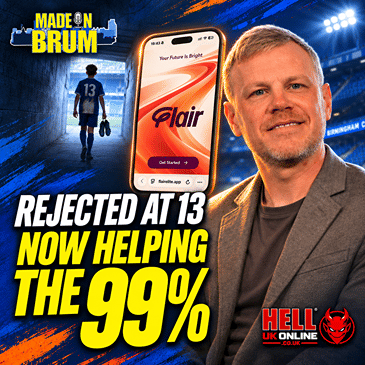
At just 13, Michael Parsons was released by Coventry City and told he wasn’t good enough. That rejection stayed with him—and ultimately inspired a mission to help athletes prepare for life beyond the game.
Michael joins the Made in Brum Podcast to explain why so many talented academy players are left without a clear direction when their football journey ends, and how Flair Elite is creating the safety net he believes sport desperately needs.
We discuss:
⚽ Michael’s experience of academy rejection
🧠 The emotional impact of being released
📉 Why so few academy players reach the professional game
🎓 Education, employment and life after football
📱 Flair Elite’s Skills Passport and career-matching platform
💼 Turning sporting experience into valuable workplace skills
🤝 Helping clubs support players through difficult transitions
🔵 Michael’s time behind the scenes at Coventry City
Flair Elite helps athletes recognise that they are more than just footballers—connecting their skills and experience with education, training and employment opportunities.
More than just a footballer.
Your skills. Your next chapter.
Discover Flair Elite: https://flairelite.app
Subscribe to Made in Brum for more honest conversations with the people shaping sport, business and Birmingham.
[00:00:00] And my own history of 13, I was told I wasn't good enough and was told we ain't going to have you within the academy. So from that point of view, I started to realise that people's dreams get shattered. And if you're six, seven, eight years of age and you come through to 16, 17, 18, it's all you've known.
[00:00:18] S8 Ep9 find a level. It's trying to find that medium level of how do we help the ones that don't make it and how do you make it better going forward? And that's what we've tried to do really. So it's a case of bringing then youngsters like 16, 15, 16, 17 have been told no, actually helping them get into either further education or into apprenticeships or into a job.
[00:00:42] S8 Ep9 Yeah, so we are using AI from that point of view because you're going to have skills that are transferable. So if you've been the captain of an academy for that year, for example, leadership skills, they're huge. We miss the little things that count sometimes. And that's what I'm saying about having that interaction engagement, because then things count for the way the person interacts with people, the way the person leads people.
[00:01:08] Made in Brum is proudly powered by Hell Energy. Need a boost? Get your hands on Hell Energy and get 15% off when you order online. Just use code MIB15OFF at checkout. That's MIB15OFF for 15% off your order. Hell Energy. Power like hell. Proud sponsor of the Made in Brum podcast. Today we're joined by Michael from Flair Elite. Morning. Good morning. Morning. That was quite formal considering. Very.
[00:01:40] Dan the Blues, he said you've frequented it. Cov fan? Yeah, commentary fan, yes. So you've shared this crime with us as well? Well, I've shared it and won a trophy here as well. You have, yeah. We won't talk about that so much. I bet we wouldn't, yeah. So it's been great to have you in. So tell us a bit about yourself in an introductory paragraph.
[00:02:03] I suppose about me. Youngster who was madly passionate about football, loved football, was one of them that 7 o'clock on a Saturday morning when Soccer AM used to come on and be downstairs at the age of 14, 15. And my dad would be like, oh God, here he goes again. He's downstairs watching that and fretting to turn off Sky Sports so I can watch it, that sort of thing. Was that a, did you have to turn it down and Soccer X came on? As the glory dies of a soccer I am. Yeah, that was definitely cool. Why are you watching this? Oh.
[00:02:33] Oh. Yeah, then your dad sits next to you watching it himself. Yeah, I suppose just madly passionate, really into my football. Obviously grew up as a Coventry City fan. He did help at the age of four, obviously then winning in a fake-up. Obviously helped a little bit with nothing since, but from that point of view. Back in the Prem then? Yeah, back in the golden land. Yeah, yeah, I think 2016-17 was the turnaround.
[00:03:00] Obviously they won, they obviously won the JPT trophy while getting relegated. And then the next year Mark Robbins got his head in gear and sort of turned it around from that point of view. And yeah, ever since then, from that period on, it's just been positive, positive stuff. So back in 2014, 15, 16, and you've got 3, 4, 5,000 fans per week. Now you've got 30,000 every week. Going up there, watching it, and big game tonight now. So yeah. What do you think this season?
[00:03:29] I think we'll stay up. Yeah. Yeah, I do. I think the first four games, I think... Well, you've got Man City going down first, haven't you? And then two more from the rest. Yeah, we'll go through that one in a bit, I think. But yeah, you have, yeah. Fulham don't look great, do they? They're struggling a little bit. Tottenham don't look great, to be honest, neither. Although they're creating chances, so I think it will come for them. But yeah, I think when you look at it, the first four games, apart from Hull, who you expect
[00:03:57] to be down there, I think the other three are going to be up there. Yeah. And we're in the top three or four now, aren't they? So I think they're probably either top three, probably. So Brighton look great, and they did terrors apart, in fairness. Arsenal, Man City, Sweetsbury South. But the Man City game, we could have... If anybody actually watches that game, that has a look at it, we could have actually got something out of that game. And I think we're one of the only teams that have said that this season so far. So very unlucky. But you won't get them points back, won't you? Yeah, you get the points back, yeah.
[00:04:26] Yeah, when they get those deducted. Yeah. But no, I think a great win against Forest. I think tonight will be interesting. I fancy us at home, Monday night, going to Newcastle. And it's a nice one for me, because my great-grandad was a Newcastle fan. So I always quite like watching Coventry-Newcastle, because he moved to Coventry back in the sort of 50s, 60s. And yeah, from that point on, I started supporting Coventry as well as Newcastle. And you played a part in this journey?
[00:04:56] A little bit, yeah. Yeah, a little bit. Tell us about working for Coventry. Yeah, so basically I owned my own business back in 2011, 2012. Started the business. 2012, I think it was. I was at a wedding. And I was the best man at a wedding, so I was a little bit inebriated. And had Steve Wagon. All the best stories come from a wedding, though. Yeah, they do, don't they?
[00:05:22] Well, I think the call was Steve Wagon and Tim Fisher had come back to the hotel to grab me for a conversation at about half 11 at night. And I think the words were, you were swinging a couple of rise maids around the dance floor, so we left you to it. So I was like, okay, fair enough. Good lads. But the next morning I was hanging and heading my breakfast, got a tap on the shoulder and said, we've heard quite a bit about you and what you're trying to do with your business, your industry, how you're changing it.
[00:05:49] And we need people like you around the club, because at that point the club was in a mess, a real mess. So yeah, so still good friends with Steve Wagon now. In fact, he's actually a part of what we're doing. And Steve brought me in, showed me the ropes, taught me a lot, taught me a lot about football, taught me a lot about the off the pitch stuff as much as on the pitch. And I always wanted to play for the club, always wanted to be a professional footballer
[00:06:13] as most youngsters do, and then realised there's more than one avenue, there's more than one way. And yeah, got involved and watched a bit of success as I got involved. So really good. Class? So let's move on. What led you to start a lease? Was it back then you had the idea? Has it been brimming through? Yeah.
[00:06:37] So basically in 2014-15, I started to realise I could only name four or five players that had come through the academy at Coventry, or coming through the academy that would potentially make it. And I'm thinking four or five out of an age group from under sevens, under eights, all the way through to under eighteens isn't a massive amount of numbers, is it? So I'm sat there thinking, why is that? And I started to look into it and realise there was a lot that went on when players get released.
[00:07:06] And my own history at 13, I was told I wasn't good enough. And I was told, we ain't going to have you within the academy. So from that point of view, I started to realise that people's dreams get shattered. And if you're six, seven, eight years of age and you come through to 16, 17, 18, it's all you've known. If we sit here now, how many can either of you remember things from the age of five, six, seven? You probably have the odd little memory here and there.
[00:07:36] If you go back and you look at players like Stuart Pearce, I absolutely love Stuart Pearce. I think he's a great footballer, brilliant guy. And if you look back, he got spotted at a non-league club. You know, I think Bobby Gould spotted him. That doesn't happen anymore because at six, seven, eight, they're put into academies. And that all came from the FA. So a guy that I know really well is David Davis, who was the chief executive of the FA. And they came up with a system. I can't remember the acronym now.
[00:08:05] It's something like FPPP or FLL or something like that. But it basically was based on the Dutch model. And it was bring as many into the academies. The best play, the best brings the cream on top. And then what you end up having is clubs and the national team, for example, ends up being more successful because you've got the better. The best playing the best creates the cream, doesn't it, in that sense? And that's what they try to do.
[00:08:34] And in fairness, if you look at that, they've done it because England have made, was it two, three finals now in the last 12, 16 years. So from when they set that agenda to how they did it, Gareth Southgate come in and bought into that idea and added his own stuff into that idea. I think there's more around that than people realise. I think Southgate was a big, big instrument in that and a big influencer in how it happened. And I think it worked. Just didn't quite get the trophy to go with it.
[00:09:03] Well, not at that level, are we? But the youth teams through the England set-up have been successful, haven't they? And have been champions. Yeah, and they've won trophies. And Dominic Cavett-Limmin, for example, he's won trophies for England and has come through. And you wouldn't say he's the best striker that England had. But if he's winning trophies, then obviously something's working, isn't it? So I think from that point of view, the system that they created was great.
[00:09:27] But like anything in life, when you create something that's really good, there is something in the background that isn't going to be right. And for me, what wasn't right was the fact that I finally then get released. So I started to look into it and started to realise that there was drug addictions, there was alcohol issues, there was even suicides. And there's a couple of notable ones. Obviously, the Man City lad is a notable one that happened. And for me, that is something we need to try and eradicate.
[00:09:57] And how do we stop that? Could it have been avoided? Yeah. Well, it's hard to say could it have been avoided or not. I think one of the issues is that obviously us as men, we know ourselves that there's a high rate of suicides. And this is an area where if at six or seven, you think you're going to be a professional footballer and at 17, 18, 19, you're told, no, you're not. Your world comes crushing down. What are we going to do next? And the other thing that's an issue for me is at 14 years of age at school, you're picking options.
[00:10:27] At 14 years of age, you're being told you've got these two years to make yourself the best you can be to come through and literally be a professional footballer. Because at 16, you're being told you're going to earn a scholarship. So the two things happen at the same time. So you're trying to divide it. And then you're taught that you have to put everything into one thing and have things around you in a basket in case it doesn't go right. So it's a lot at that age as well. It's a lot to take on. That's developmentally for a teenage boy.
[00:10:57] Yeah, that's like a crucial time for brain development and emotionally, isn't it? Yeah. There's lots of take on. And also for parents. And a lot of the parents, they might have also been in the same position. Their dad had an opportunity, might have been in an academy, didn't quite work out, or tried to get into an academy. Or his mates been in an academy. And then their lad comes through and, oh, yeah, he's going to do it. And he gets into the academy. And all of a sudden you think, oh, he's going to make it.
[00:11:22] But you spend time and effort like taxiing everywhere, don't you? You know, you do all of that. You pay subs. You pay money out. And you do it because you love your kid and you want your kid to have the best. And it's hard because, in my opinion, a lot of the academy trainers or execs will actually know whether that player has or hasn't got an opportunity. So you've got age groups and you've got 15 to 20 in that age group.
[00:11:52] Well, there's no way 15 to 20 in that age group can make it into the team, can they? Do you know what, additionally to that as well, what are your thoughts on the affiliations from clubs where they lie parents to pay? Because I know some parents that say, oh, he's with West Bromers, he's with Leicester. And they're not. With this affiliate where they pay to be a part of the club on the outskirts. Yeah. Because with that, wouldn't you even say then that the clubs will know the kids that are in the actual academies? They know the levels of those kids.
[00:12:21] But they will know that the kids that aren't in the academy that are in these kind of affiliates aren't going to become the level they need, aren't they also? Yeah. It's difficult, isn't it? Because if you sort of go back in time and you look at like Saville and Roy or Jamie Vardy, they're people that made it later in life compared to most. So you're going to have ones in these affiliates that probably are, there's some that might be good enough, but you might not realise it yet. And it might be later on.
[00:12:51] So it's a way in which they can obviously bring them through at that point. But it's difficult, isn't it? Because it's monetary value comes into it. You know, what you're paying for, what you're doing. But then they've got coaches, they've got equipment, they've got pitches to look after. There's a lot to look after and a lot to do. So it's trying to work out what's right for them and what's right for you as a person. And for me, that's why flair came about in the way that it did.
[00:13:20] And I called it flair elite. And the reason I called it flair elite was because these people have flair. They have something about them. They've been in these academies. They have an ability. And it's somebody there who says yes or no. And very, very fine lines. They say that there's fine line between being an absolute idiot and a genius. Like there's an absolute fine line. There's the same fine line between being a successful footballer and not. It's a real fine line.
[00:13:49] And I think for me, as I looked at it, it was, okay, this is the system that's been set up. It's working for the national team. It's working for the clubs. It's working to bring these people through. But how do we create that safety net? How do we create the second, third or fourth chance behind it? So the idea came about trying to see your questions back in 2015 when I'm sat there and I'm watching James Madison's come through.
[00:14:17] We've got Jacob Murphy on loan and Adam Armstrong on loan as well. I'm sat at Coventry watching them and I'm thinking Ryan Kent's there and they're all doing their scholarships and they've all just come through. Some fires are that, isn't it? Yeah, it is. I mean, you think back now what they've done and achieved in that last 10, 11 years. But you look and go, are they going to make it? Are they going to come through? You know, you've got Tom Bain, this who played at Coventry. And you've got a few others that come through and didn't quite get to the same levels, but then have made successful careers.
[00:14:45] But the point is as well, it's not just the ones that don't make it. It's the ones that come in and haven't had the successful career at the top level, but have had a successful career around championship league one, league two, even the national league. And then as we've spoke about before this, like the Southern Prem and the non-league, the semi-pro sort of non-league structure is they've all put time, effort, played, got paid, but they've got masses and amounts of money from it.
[00:15:14] They've got enough to keep them going for them years. But then at 32 to 36, 37, come out of it and go, what do I do next? Where do I go? So Flair Elite was set up around academy players that come through the system. At 16 are told, look, we're not going to take you on. They're left with nothing. It's like their school's gone down. Well, school education has gone down the pan because they've been concentrating trying to make it as a footballer. Which has been encouraged by the clubs. Yeah, of course it is. It is encouraged.
[00:15:44] And you can't stop that. You can't stop not encouraging it because they'll be the odd player. If you go back years again, you go back to Robbie Fowler and Kevin Gallon. If you go back to people that were around them two at the time, Kevin Gallon was the one that they all thought was going to be the player. Yet Robbie Fowler ended up being the player in that sense. Kevin Gallon didn't make it into the England squad and go on to do what he did. But if you look at his record in the under 18s, 19s, it was as good as Ennis. Yes. So, you know, players have, like we all do, we have our peaks in life, don't we? And it's when they peak and when they don't.
[00:16:14] He probably peaks 18, 19, 20, 21. Whereas Fowler may be peak 21, 22, 23 and comes through in that sense. Yeah. So that happens. And you can't stop the encouragement. You can't stop the coaches from wanting them to do well and to carry on because that's what they're there to do. They're there to encourage. They're there to try and improve them. And some of them will get improved and they'll tell you that they've sat there and A, B and C players look like they're going to make it. But then D, E and F actually come through and do really well and they go with them instead.
[00:16:44] So it's trying to find a level. It's trying to find that medium level of how do we help the ones that don't make it and how do we make it better going forward? And that's what we've tried to do, really. So it's a case of bringing them youngsters, like 16, 15, 16, 17 and have been told no, actually helping them get into either further education or into apprenticeships or into a job.
[00:17:10] And with what we've done with Flair Elite is we've managed to create an ecosystem that allows them to come through, get well-being and support. Because, you know, you're shattering their dreams at 16, 17, 18. You're shattering them dreams. That's all they've dreamt about since they're just six, seven. Yeah, I imagine you can't just go, right, no. What are you into? Do you like anything? Do you like building? Do you like, you know, engineering? And they're just sitting there thinking, I just want this place.
[00:17:35] I mean, what does it look like nowadays or before this where you're just getting let go? What does it look like if someone sits them down like this? Is it an email? Is it a text message? And they just go, there's the door. It's a lot better than it used to be. Now you'll have like the academy director or the chief exec of the club, for example, at some clubs. You'll have two, three people around them who say, look, you know, unfortunately you're not going to make it.
[00:18:05] Don't take away the fact that they don't want to have that conversation neither. It's not something they want to do. It's not something they like doing. They're breaking someone's heart in that sense and telling them that their future isn't in what they want it to be in. So from that point of view, like it's not their fault. They've just got to make them decisions and go forward with what's right for the club. And that's their job. Their job's to do what's right for the club. For me, I look at it and go, how do we make it so that it's not so much pressure on them?
[00:18:33] There's not pressure on the youngster. How do we help that youngster come through? How do we give them another chance, basically? Another way forward. And for me, you've got to remember, it's 99% don't make it. So it's the majority. You're not the minority. You are the majority. Yet the hurt and the pain you'll feel makes you feel like the minority. So it's about bringing them together.
[00:18:59] It's about making them see what they've gone through together, having that support, giving them the wellbeing and support, which we're doing through the app. And then what is there out there for them to do next? And creating that ecosystem around even the education, giving them the alternative providers, working with the PFA, working with the UCFB, working with them to give them the best opportunity by giving the education they might want to go forward.
[00:19:26] Or working with Topps Training, for example, they're an apprenticeship provider. Working with them on apprenticeships. Because some won't want to go into football because of what they've done. Yeah. And some of them will. And that ecosystem's there. And the other thing to think about is part of Flair that we've created as well is that we've created a recruitment side of it. So the app actually has a recruitment side.
[00:19:53] Clubs, associations, leagues can be on there themselves. Instead of paying 15% to 25% for them to headhunt for staff, they can pay a subscription amount per month, which saves them a hell of a lot of money compared to the commission. Yeah. And then what we've done is we've created something that allows the job to be matched to the people rather than 150 to 200 CVs coming in.
[00:20:20] Clubs, associations, businesses sitting there, sieving through them, trying to find the ones that are right, the ones that are not right. Because, you know, yourself, football is a massive industry. Everybody likes it. A job comes up. People that haven't even been in the industry or think they have transferable skills but don't have them transferable skills will still apply. And you're going through them to see the transitive amount. What we've done is we can match the job to the people.
[00:20:46] So it gives the clubs five, ten candidates that actually these skill sets match. Discrimination comes out the window as well because it doesn't go off anything other than your skill sets. It's just employee A, employee B, employee C. Yeah. There's no face or gender or race or anything. No, I think it's your skill set. Do your skill sets match what they're looking for? If you look at dating apps, here we go, going back to your earlier conversation now.
[00:21:13] Literally, if you look at dating apps, for example, they match people to people on their interests. So my background was I was an engineer. So I've reverse engineered it, looked at it and gone, hang on a minute, we're getting 150, 200 CVs coming through. That takes hours. I think it's 100 CVs will take you 8.3 hours, which basically is a day's work, isn't it? Yeah. Put your brake in there, that's your day's work.
[00:21:41] So from that point of view, if you've got nearly 200 CVs, you're looking at two days. Just to siv through, by the way, which ones have... May or may not be. Yeah. Do you find at that point, what's the education like of the CVs that you've got coming through? Are the lads typically really good CVs or do you get something to first on the little of trouble, pens pay? Well, no, this is the point. So what we've created on the app is actually looking at their interests.
[00:22:09] So if you've been in an academy from the age of 6, 7, 8 years of age, your knowledge on that industry is ahead of anybody else. Nobody else can compete in that industry. Yeah. From a sporting point of view. Forget football now. If you go bigger and you go sport, because this will go every sport, it will go every country and it will go past that. We're working with the DWP at the moment as well.
[00:22:35] They were putting us out there with job centres and NEATS and the rest of it because it will work in different areas, different industries. But sport was where I wanted to start it because that's where the idea came from. So from my point of view is we've done a CV creator. And I know with AI, people are very dubious about the way AI works. But we've done it in a different way. We've worked on it of understanding what that person's been through or where they've been.
[00:23:00] So asking questions about them, getting the buy-in from them, not too many questions. It's boring. You sat there typing out, although we have just put a voice note recognition on the app as well so they can talk into it. Class. But what that does is it means you start to understand the person. Because for me, what's lost now when you have these recruiters in the middle, it's CVs they're looking at. They're not looking at the person. They're not spending time in the person.
[00:23:28] Not like you and I are now, face to face, getting to know that person inside out and get a feel for that person of what they're like. That goes out the window. And that's why I think when people are employed, you end up three months down the line, the employer isn't happy or the employee isn't happy. It hasn't quite worked. It hasn't quite fit because the engagement's gone. Yeah. See, in our business, we've had to recruit from COVID considerably. We've been in now.
[00:23:54] And what I found was, because I was doing it directly, and I'd have people phoning me, offering me clients. When I've been on CV library and I've seen the CV of the person they're talking about, and I know I'm already talking to them. And I'll ask them if they've spoken to this recruiter and they've never even met them or spoken to them. So you've got recruiters farming CVs off CV library to potential employers without even speaking to the person. I assume then if there's interest, they'll go back to them. Oh, I found you. Yeah.
[00:24:21] But it's become such a, like you say, it's such an unusual industry, hasn't it? Where, like you say, the personal touch is gone. Yeah. And you're not actually meeting the person that you're dealing with. You don't know them. No, you don't. And to be fair, I've got a contract here for you to sign for you to come on as an employer. So it's fine. Done. That's done. Signed. Agreed. So how do you help the applicants recognise? So you go back to they will have such a vast experience of being in that industry.
[00:24:51] Yeah. What about the people who have just got that? How do you help them recognise what skills they've got that they don't particularly know themselves? Yeah. So we are using AI from that point of view because you're going to have skills that are transferable. So if you've been the captain of an academy for that year, for example, leadership skills, they're huge. You know, we miss the little things that count sometimes. And that's what I'm saying about having that interaction and engagement, because then things
[00:25:19] count for the way the person interacts with people, the way the person leads people, the way the person talks to them and buys them into what they're creating and doing. So for me, for example, people will tell you I'm really open. I'm too open in some ways. But that brings buy-in. Like I won't say, like even with Flair, this idea has been a 10, well, it's 11 years now. It's been an 11 year idea. But even now I'm going, OK, I want to get to Newcastle.
[00:25:49] My goal is to get to Newcastle. If I know that I'm going up the M1, the A1, then I know I can get there. But then I might have an accident or I might have a breakdown. I think the car might break down. So I might have to get out the car and I might have to go to the train station and get a train. But there's more than one way to get to your destination. And there's more than one way to achieve something. So you can't just say that's how I'm going to get there and what I'm going to set out and buy into. You have to say, OK, we have to be adaptable.
[00:26:18] We have to know that we might have to move a different way. But you set your goal of what your goal is to achieve that goal. And for me, if you don't know your destination, are you ever going to get there? So from that point of view, that's what we've tried to do. So we're using the AI to take note of, obviously, what's being said to it from the interests and the skills they've learned and then using them as transferable skills. What do they relate to?
[00:26:45] Because transferable skills is a big thing for me. I always thought, having been involved in the automotive industry from the age of 16 to 34, at that point, I went, oh, my God, what do I do with myself? And I thought that was all I knew. And then I realised that's not what I knew. I liked business. I like the intricacies. I like putting together plans. And I could see things and I could see opportunities. And Flair isn't the only thing that I've got up and going at the moment.
[00:27:14] There is a sports tech group, which we've created, which has got three businesses underneath it that will complement each other, but will hopefully make things better for sport going forward. And like you say, it's product knowledge. Product knowledge is probably the easiest thing to learn, isn't it? It's the key. So if you've got all the other skills from the background so that you're putting towards that job,
[00:27:38] product knowledge is just finding out everything about what you're selling or what you're trying to go into meetings and do. So it's the rest of the skills that complement that then, if you know what I mean. Yeah, no, you're spot on because product knowledge, if you look at it, we've looked at it and said, where are the pinch points for the youngsters? What's the issue? The issue is they can't find the path. They can't find what's next.
[00:28:03] Can't find it there because it's not there in front of all, which is really strange and weird when you look at it as a digital world that it is now. Digital transformation we've gone through, you thought that made it easier. Flair would probably have been born eight years, seven years ago if it hadn't been for the fact that we needed more from the digital side to help it, to move it on, to make it what it is now.
[00:28:25] There's no doubt in my mind that them years have helped me because them years I've had contacts within the DCMS, within the DWP. That's all come to fruition now because of the idea. I mean, I just had a conversation with somebody at the DCMS and said, well, this is my next venture. This is what I want to do. And he went, hang on a minute, you need to speak to DWP. And I went, no, no, not for 18, 24 months because I want to get it set in football first. No, no, you need to speak to them now because they've got an idea that's coming out and this is going to complement it, work with it.
[00:28:53] And next thing I know, I'm going to call with 113 job centres. And I'm like, well, OK. So from that point of view is that you're working towards these things and things happen for a reason. But it's the second chances and the things we can give out. So for me, it's about doing that because you look at their pinch points and you look at the educators pinch points. They're trying to find these people themselves. So it's quite difficult.
[00:29:23] Well, if you've got a platform and everybody's on it, it's easy to find them, get them enrolled, come through quite quickly, quite easily, put them through the courses, get the education they need. But then from a business's point of view, what's their pinch point? What's their issues? Got to sieve through 200 CVs. Take two, three people out of the business for two, three days to go through them CVs before you'd even thought about how many of them that you're then going to bring forward for an interview.
[00:29:47] How many of them are you going to sit in that time, taking that interview, doing the interview, then going back to them. It takes weeks, months, like two, three months now for someone to get a job. Whereas we can speed the processor. We can take the time element out. So time efficiency comes in, cost efficiency comes in, you know, and actually earning from it. So everybody earns.
[00:30:09] And that's where with the football clubs and the associations, the money that's plowed into the sport to set the academies up, to function, to pay the wages and everything else. And then players disappear and they don't see them again. Well, actually, if we bring them through the ecosystem, somebody in the academy might be great with marketing. Somebody might be great with numbers and want to be a trainee FD and go through an AAT. You can do that through this system. And the club then actually has a benefit of the money that's been paying out for that person.
[00:30:39] So for me, it's an ecosystem in that sense. Yeah. Especially at Premier League level, it's absolutely awash with money, isn't it? Yeah. I wish I could come further down the food chain, not so much, but the Premier League is awash with money, isn't it? Yeah. For them to be able to kind of, like you said, put money in and circulate that round. The unemployment in young people is a record high as well, isn't it? Which, I don't know you're saying it starts with sport, but do you see, because I imagine this is entirely scalable. There's no roof on it, is there?
[00:31:08] Where's the ceiling? There isn't a ceiling, is there? No. I've been trying to put a lid on it and keep a lid on it. But if I'm honest, I don't think we can. And it's about now making sure that we're in a position to bring the right people around us to help us build this correctly. And make sure that when it goes, it goes in the right way. I personally believe this is something the government should be involved in.
[00:31:34] I have been talking with my contacts in the DCMS and in the DWP in regards to taking it to a higher level, to Parliament, because I think we can reduce the NEAT numbers, which is huge. I think the stats were 981,000 back in April, June time of registered on NEATS. But I think it's up to 1.012 million now. And it will rise again. That's crazy, isn't it?
[00:32:02] All these kids with the enthusiasm and zest for life that are just starting out, you know. And that's only 16 to 24. And then you look at that and say, well, OK, that's 16 to 24. And then you say, well, OK, that's probably because that's the pinch point from that angle. But then, like we said about sport, if you're in sport and you're coming out of sport, it's like, well, what's next? What do I do? So we don't think this is just around academies.
[00:32:26] This is also around people coming out of the sport or are released after the scholarships at 19, 20, 21, and have dropped down leagues and don't know what's next, might need, might go into semi-pro football, but need a full-time job. You know, it's there for them. It's there for them to use. It's there for professional footballers that are coming out. And there's some I've seen in League One, League Two that have either committed suicide or have gone into drink and drugs and stuff, not knowing what's next and things like that. And their lives get wrecked. We're here.
[00:32:55] We're here to stop that. For me, we're not going to be able to stop everything. Of course, we're not. And I'm not daft enough to think we're going to do it 100%. But if we can get 80%, 90% and help them, then that's it for me. But even with the Premier League players coming out that are starting successful businesses, if they're aware of it in their club and how well it's doing in the club, and they're going to want, I say, lads and girls who are that way inclined, aren't they?
[00:33:24] So they're going to come straight to that. Because one of the questions is, how does sport set people up to be that kind of frame of mind? I think we touched upon it earlier that if someone's the captain of the team, but it also gives you, you've got to be on time. At the same time, you've got just the little things that maybe other people may not have kind of gone through. Yeah.
[00:33:51] That's, I think what I'm trying to say is that people who have got businesses that are associated with the clubs, then will automatically come and be like, okay, let's get on that app. How do businesses typically get involved with you? Just before we touch on that, you're making a really good point because you're in an environment where you're with, it's camaraderie, isn't it? So you're in that environment where you're with people all the time, and you are bound by the rules in a good way, and you sit to them.
[00:34:21] So let's take... Exactly where I was going. So if you then take another industry, take the army, for example. This is where it'll work for the army as well. And I know somebody that was involved in the SAS, and they came out and had transferable skills that were noticed, seen, went to a very big company as the managing director, was very successful, helped the business grow massively. And he's somebody that I work, you know, I've got a lot of time for,
[00:34:50] and I'm actually meeting him at some point this week again to go through this, is because you learn things. You learn... People call it regimented, but you do... Some of it has to be regimented. You need a bit of both. You need a bit of flair. Fundamentals, isn't it? Yeah. You need a bit of flair, which is why we call it flair. You need a bit of... You know, you need a bit of a regiment and the fundamentals that make it work. And it's a process, and that process-driven stuff is as important as somebody having that flair and vision.
[00:35:17] So the two come together, and in successful businesses, quite often, that's how it works. You've got a couple of people in there, a bit of flair and a bit of knowledge, and you might know the industry and see opportunities, visionaries, but you've got the process-driven people there who are just as important. Exactly. Like a football team, isn't it? Exactly. You've got your defenders, solid. Do a job. Get Bassett out. Do the dirty water. Let the flair men do what I do.
[00:35:44] Even the CDMs, the water carriers, the Torn McAlellius, you know what I mean? Do it. Give it to... Most underrated position in football, but one of the most instrumental. Because if you've got that right person there... Matt Grimes for Coventry, for example, unbelievable. Because he'll just drop in the hole. He'll basically become part of a three at the back. Drop in the hole, pick the ball, spray it. He's got great left foot. He can ping a ball, turn five. Give it to them, and they can go on. Yeah, 30, 40 yards are not a problem.
[00:36:12] Yeah, and you're literally ping it off and off they go. And it... What it means is... Or if you look at it, it's every single job. Every single thing we do in the world. It's teamwork. It is teamwork. It is... You can't be successful without it. You can't be successful without the right people around you. And I think one of the things I always go back to, and there's years gone by, and I can't remember the exact phrase, but basically it was...
[00:36:41] It was the guy that owned Virgin. What was Nick Branson? Richard Branson. Richard Branson said, bring in people around you that are better than you. And people thought, well, what do you mean by that? What it means is, is in them areas, in them positions. So if you're a central midfielder, you're not going to try and go as a right winger, are you? Or a striker. You bring somebody in around you. Right back maze. Is it? Left back in the changing room. But literally, you bring in the people around you in them positions. It's no different in a business.
[00:37:09] You bring people around you, one that knows accountancy, one that knows purchasing, one that knows sales. You do exactly the same thing. It's exactly the same methods, just in a different industry. And it's key. And then going on to your point about businesses. Businesses can... So the app now actually is complete and done. We are currently testing it and going through the processes with it. And we can send it out to people.
[00:37:39] So if anybody did want to pilot it and have a look at it and work with us on it over the next couple of weeks before it goes live, then they can contact us. So they can use the contact form that's on www.flareleet.com and Flares, F-L-A-I-R. Or they can reach out, obviously, onto our emails, which are also on there as well. But my email is Mick at Flares Elite dot com. Put all the bump in for you. Yeah.
[00:38:09] Put it all in. What's... So this started off as that kind of idea. What's been the biggest challenges so far? Because as far as I can see, people are just... And we spoke about it briefly on the phone. And you've talked about it then. The government must be just like, how much? It's not the size, isn't it? The best ideas are the ones that once someone comes up with it, everyone goes, why don't we think that? So I always say, I'm very simplistic.
[00:38:39] I don't like things difficult or hard. I simplify everything. And for me, as I said earlier, the app itself is just reverse engineered from other processes. So reverse engineering to make things easier for businesses, to make things easier for people coming on board, to make things easier for educators and having that area. The government, for example, we're reaching out to contacts and trying to get through in certain ways. And who knows, one of them might be listening to this and think actually that's a great idea.
[00:39:09] You know, MPs and people like that would be instrumental in moving this forward. It is for education. It is for employment. And for me, I think we can create a legacy. I think it's a legacy that can be created. I think it's something we could look back in 10 years time and go, wow, that was unbelievable. And if we can help people, then that's all we want to do with it, really. Yeah. 10 years time, you're looking back at how did we not deal with that? Do you remember? Yeah. But again, like I say...
[00:39:38] Remember the industry before this and over? No, I don't remember. Eight years ago, with AI now and all the algorithm stuff and all the stuff that's come to fruition over the past even two or three years, it's just a light bulb to you. Like, yeah. It's like a... The key. Because trying to do this back in the day, it wouldn't have been laborious, wouldn't it? Because you would have had to have people on call. You find a fine line, though, with the AR integration. AR. AR? AR?
[00:40:08] You're coming on to my point. You're coming on to exactly what I'm about to say to you. Okay. If we're going the same way, you need to be careful with how much of the human touch reminds in this process. Absolutely. Absolutely spot on. You literally get... Where I went to butto there was literally where I was going because the interjection was the fact of we're using AI as an assistant. It's not going to take the business over. It's not going to be, okay, sit down and let that do the business. That's not what it's about. For me, it's about making sure the human touch is back,
[00:40:37] which is what I touched on earlier, was where's the engagement gone? It's gone into the employer speaks to Indeed or CV Library or whoever else is out there and goes, okay, this is what we need, what we want. And then they go out and try and find that person. There's no interaction. Now, I know the reasons why that went that way is because businesses would have been inundated years gone by before they came about, been inundated with CVs that weren't relevant. So actually, how do you change that? You do it the other way around. You match the job to the person.
[00:41:08] And that's why I created it that way around brings the engagement back, but it uses the AI to assist in making it the right method and the right way around. Yeah. And that was the key, was just reverse engineering it to make it work efficiently and cost effectively for all parties, but also allowing the youngsters then to be able to come into, because the NEIC numbers are growing because they can't find the pathway. And I'd imagine as well,
[00:41:35] the kind of your target demographic at that age of children, essentially, I'd imagine coming away from academies, the confidence is absolute rock bottom, isn't it? And just logging onto websites or, you know, trying to find jobs or whatever is non-impossible at that point, isn't it? Where you need to be able to, like I say, what you're doing, where you speak to them on a level, find out their skills. Now, imagine the NEIC quite a lot of bringing back up and inflating again, don't they? It's, we did a strapline for Flair,
[00:42:05] which was We Are The 99, because numbers are massive in sports, aren't they? So, you know, everyone's got a number on their back. Everyone's part of something. Yeah. That was about making them a part of it, bringing them into it, because you're not a minority in that. You're not alone. World. Yeah, you've got, you've got 99% of you are going through that. And actually, not just that, if you then go to your parents and ask your parents, like, have they been through it? Or family members,
[00:42:34] or their friends. Every conversation I've had with somebody, they've either gone through it themselves, or their niece, or nephew, or uncle, or auntie, or brother, or sister, have gone through it. And, and, or a friend's gone through it. So, that tells you that it's a numbers game. It's bringing as many in, into all them sports, and getting them all into it, and playing as much as they can, and getting the best against the best to get the cream out on top.
[00:43:03] And then it's a case of, okay, they've fell out. So, they've fought out that system. Well, what we're trying to do is, is for them to, when they're falling out, it's not like, like the old filter, they fall out like that. They're falling out that way. Yeah. Because it's the majority. It's the most, I think it's going that way around. So, from that point of view, it's like, okay, how do we pick all of that up, and bring it back, and then filter it back in? Yeah. Back to you. What would success look like, for you over the next year? I know you've told us this kind of,
[00:43:34] people are trying to push and pull you, for other industries, but, you seem like you want to be kind of like, let's establish ourselves doing this, and get all the teething problems out the way, if any, in this industry, and then we can, but people are like, we want it now. I haven't got a problem, but people want it now. That's the, that's the world now, isn't it? That's, that's the story. In stock gratification. Yeah. Literally, I mean, you sit outside McDonald's for more than 30 seconds, and the kids are asking where the burgers are, aren't they? So, that's, that's the world we live in now.
[00:44:04] Success for me, is, actually just helping people. How, watching these youngsters, come through the app, going to education, apprenticeships, employment, and actually seeing it work, and seeing the numbers of needs drop. Success for me, is actually, getting the app, in front of people. Because if they, if they don't want it, then there's a reason they don't want it, and that's fine. You know, if people tell me, I don't want that, then that's absolutely fine. But it's there if you need it. So, is it as simple as, I'm watching this now,
[00:44:34] I'm in need of some assistance, I've come out of football, I'm just doing nothing, I don't know what to do. Is it as simple as just downloading the app, Yeah. And registering? Yeah. Download the app, register. So, on the app itself, and I, what I can do is, I'll email you both, like some of the, like the video and the snippets of, obviously what we've created, and you can put that out with it if you want to. Literally, it's go on, I'm an individual, I'm an educator,
[00:45:27] or training provider, through the job centers, obviously they've been referred by the DWP. You can click, refer by the DWP with one of the others, because the DWP actually work with the Premier League, the EFL, and other leagues and clubs, on players that have it made, and how they help them come through. And hopefully we're the missing piece that helps them. And it seems like it's all done on the phone, you don't need to, because laptops are, unless you're professional these days, or of a certain age, that the kids aren't asked about laptops, are they?
[00:45:57] So it's like, is it all done through the phone? Yeah, from an individual point of view, they can do everything through the phone, everything, and notifications will come through 10, and they've been matched to jobs. And based, obviously from an employer point of view, they can do it through the web as well. So it's not just a phone, they can do it from the web. Like you said, a professional, you sat there with your laptop, looking to put recruitment out there. How we've designed the app for an employer, is it's a separate portal. You've got a template already, you basically can, you can copy, if you've already done a job description,
[00:46:27] you can copy and paste it straight in. Literally straight in, and copy, paste, straight in, press, bang, all of a sudden, you're live. It comes free of obviously the candidates that match to the skill sets you're providing. So from that point of view, it's quite an easy process for them. Takes time out, really, for them to be able to just concentrate on the business, rather than working in it. Yeah. And work from around it. So concluding then, it's just, for me, it's just refreshing that you have got a passion for it,
[00:46:57] that you're not just kind of doing the business for the business, and it's something that you're invested in, that you know a lot about, and you know that there's a problem, and also what sticks out to me, which we touched upon it earlier, is it's just a nice, nicer conversation for academy managers, and we've had managers on here, who might watch this, and coaches, who are having to make those decisions, to be like, okay, it's not the greatest conversation. You're not what we're looking for. You're not good enough, or whatever, but, we've got this,
[00:47:28] we've got this, getting such a these guys, straight in, and this is the support, and it makes that conversation, a bit more, viable, and a bit more human, for the person doing it, that be like, okay, and then they'll be invested in, the app, to think, okay, how's this guy getting on, and it's, again, it's back into the ecosystem, and, so can you get to the point, just off the back of that, where, you are the mandatory option, at that point, at each of these clubs, so that conversation goes, this isn't happening,
[00:47:57] but, flair is happening, speak to them, this is, and they get guided directly into it. I don't want it to be mandatory. Yeah. I know that might sound weird, and daft in one set, I don't want it to be mandatory, I want them to choose it, because it's right for them. I don't want to, to be forced into going down that route. I think what we've created, is right, and I think it can work, and I think we can help, as I said, if we can help 80, 90 percent, it's fantastic,
[00:48:26] but I don't want it to become, a mandatory thing, I don't want it to be like, you have to do that, I want it to be something, where the academy directors, the chief execs, are confident, and happy to signpost them, in that direction, because that, that's more to me, than, than it being a mandatory thing, because that means, they can see it, they feel it, and it works, and your point, you just mentioned about, you know, coming to this point on it, and how, how it's created,
[00:48:55] it's actually my life, it's, it's, it's built off, experiences that I've gone through, and I've seen others go through, it's not, something where, I've just gone, bang, there's an idea, it's, I, I went through it myself, I've seen, others go through it, by being involved, at the football club, and, I've, looked into it more in depth, because I saw that opportunity, and I started to see, what the issues are, and, the other thing to, to make clear on here is, every single person,
[00:49:25] coming on, looking for an opportunity, it's free of charge for them, it's not, paid subscription, to come on and, try and find a job, that's not, for me, that's not how you find a job, by paying, or paying for someone, to create the CV, or paying, no, no, we're giving you an opportunity, to put things together, that then, you can be spotted, because the businesses, the clubs, the associations, links, whoever it may be, looking for that talent, need you as much as, you need them. So that, so the whole process is free?
[00:49:55] That process is free, the only thing that is paid, is obviously, we, we do have a commission rate, from the educators, because we need to obviously, be able to cover, hosting costs, and stuff like that, but to how, to the individual, it's just, but to yeah, to Jack Blogs, free of charge, brilliant, you don't pay for it, but Joe's brother, yeah, yeah, Joe Mide, Joe Mide, he plays for, he's an arsehole, push the palace center off, yeah, and then, from the other side of it, like for, for the educators, for example, alternative providers, they pay commission fees anyway,
[00:50:24] that's how it works, so it's no different, it's exactly the same, for employers, they're paying 15, 25% commission rates, we're doing it, on a subscription, agreement, per month, which basically, allows them, to concentrate, on what they want to do, which is run their business, out of the business right, and it saves them money, but gets people, into the positions, quicker, with the right skill sets, and it highlights, it's all about the skill sets, it's nothing about, anything else, it's the skill sets,
[00:50:54] that they require and need, and they're out there, but they just can't find it, this matches the two together. Well I suppose, something like that, with these bigger businesses, even with high turnover of staff, because I suppose, that works with even, businesses looking for seasonal stuff, and things like that. Exactly right, yeah hospitality, for football clubs, yeah, for events, the whole lot. Brilliant, no brainer, thanks for joining us, you're more than welcome, we'll include, all the flair website, with the episode, and yeah we'll get it out there.
[00:51:24] Perfect, thank you ever so much, really enjoyed it. Cheers mate, cheers mate, thank you. If you like this video, please do click, to subscribe to the channel, we currently have, five and a half thousand members, over half a million views, so let's convert some views, into memberships, and that will continue, to enable us to, bring great guests on, and continue making great podcasts. Thanks.