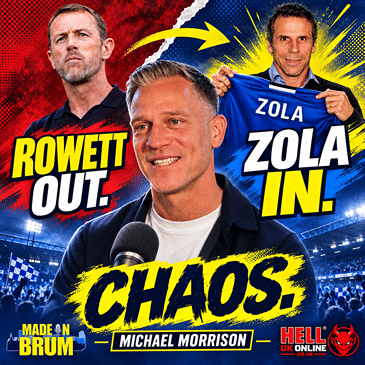
Former Birmingham City captain Michael Morrison joins Made in Brum to tell the inside story of one of the most unpredictable periods in the club’s history.
Morro reveals how Gary Rowett convinced him to join Blues—and what really happened when the manager was suddenly dismissed with the team flying high.
He takes us inside Gianfranco Zola’s disastrous first meeting, the dressing-room reaction to his appointment and the chaos that followed. Michael also recalls Harry Redknapp’s arrival, the pressure of the relegation battle and the overwhelming relief of securing Championship survival on the final day.
The conversation also covers his journey through Cambridge United, Leicester City and Charlton Athletic, becoming Birmingham City captain, working under Steve Cotterill and Garry Monk, the points deduction, his difficult departure from Blues and his move into coaching.
Above all, Michael explains why Birmingham became home—and why his family still considers itself Brummie.
⚡ Proudly sponsored by HELL Energy.
Watch, like and subscribe to Made in Brum for more honest conversations with the people who have shaped Birmingham.
🎧 Made in Brum is also available on all major podcast platforms.
#MichaelMorrison #BirminghamCity #BCFC #MadeInBrum #KeepRightOn #FootballPodcast
[00:00:00] Gary came in and was just like, oh that's it, we're done, I've been sent. And everyone was like, what? We've got Sam Baldock up front and we're like, you meant Sam Bulldock. He was the top goalscorer in the championship at the time by the way. Straight away you were like sitting there, you were kind of laughing but you're thinking, if this guy is getting the top goalscorer wrong on his first day, you're thinking, oh no, this could be a disaster. Robby Keane, Ashley Cole and John Terry and ended up with three lads from Brentford and a lad from Barnsley.
[00:00:28] No, they've all had good careers, right? But that's a different conversation. Especially if you've been in that situation, it's not a celebration of like, yeah, we're buzzing. It's like so much relief. Like, oh my God, I cannot believe that we've managed to do that because if we hadn't, we'd have been fucked. Some of the best of my career. I loved it and it was a great time. I really settled into Bermuda. I still live in Solihull now. So like, you know, I still feel like, you know, my home, my kids have got Brummie accents now.
[00:00:57] So it all stemmed from that decision of coming here on loan for, you know, what was originally a month and then extended to Christmas and then it was pretty clear that it was going to be coming up from there. Made in Brum is proudly powered by Hell Energy. Need a boost? Get your hands on Hell Energy and get 15% off when you order online. Just use code MIB15OFF at checkout. That's MIB15OFF for 15% off your order.
[00:01:23] Hell Energy. Power like hell. Proud sponsor of the Made in Brum podcast. Morning, mate. How are you? I'm good, yeah. I'm good. Keeping well. Things are going all right. So yeah, yeah, I'm enjoying myself. Good. Life after retirement. That's it. Not proper retirement, just not playing anymore. Yeah. How have you been getting on? I've had a look at the results. Well, if you've asked me three weeks ago, I'd have been buzzing. I'm loving all this coaching life. It's brilliant on the other side. And then you lose two or three in a row and it starts to be difficult.
[00:01:52] But yeah, I'm doing all right. I'm down at AFC Wimbledon, first team coach there. Claybrook the manager at Cholton. And Johnny Jackson, he's been in there for four or five years. And the sporting director is Craig Cope, who was here as an analyst when I was my first year under Gary and then under how it went out. And then he went on to Soddy on mores, the sporting director there when they lost to Grinsby in the player final.
[00:02:18] And he's doing well at Wimbledon. Obviously, they got promoted a couple of years ago and trying to stay up and leave. Small world and hit football. Yeah. It sounds like I've gone in and it's mates for, you know, people giving your mate a job. But, you know, I've done all my badges. I've done some coaching as well, just finished my pro license in the summer. So I knew it was that sort of route that I was going to go down. So I wanted to stay in football. You never quite know what that's going to look like, right? Because there's so many different jobs and you've got Wayne Rui doing a badminton job.
[00:02:45] You've got Frank Lampard doing commentary in the championship. Jack Wilshere doing Luton. So, you know, jobs can be hard to get. So when you get a first team opportunity, you have to take it no matter how much the track will is. That's it. Yeah. I remember Paul Robinson, why aren't you saying the difficulty now you've been getting in front of people for these jobs. And then you tend to get a lot of bias toward bigger players from all the big clubs and a lot of all played in the Ferguson top thing seems to get a lot of people in the right rooms. Yeah. Yeah.
[00:03:15] Players that apply for managing, oh, I'll use their management as well. And then you take their kind of thing and philosophy and you go out at the interview and you get on the train going, it's like. Yeah. And also by the time you see a first two job that's up, it's already gone. You know, if you see it online, it's already gone. And as you know, everybody's already planning for that and then jobs that you apply for sometimes already got people lined up and stuff. And it sometimes is one of them things where HR have to put it out. Right. As you see, it's hard to find jobs. Everyone wants to be in football. It's the best thing you can do if you're not playing to be to be part of it.
[00:03:45] And, you know, I'm happy to be part of them enjoying it. It's it's different. It's different, but it's fun. It's good. So growing up then, was you always into football? You was keen? You were early age or? My dad was a goalkeeper. And then my older brother was a goalkeeper. So normally you put the younger lad in goal, don't you? But my older brother was a goalie. So I was taking shots against him in the garden, which was quite nice. So that's how I sort of got into it. My older brother played for a team. He's three, four years older than me. So I would try and join him with training.
[00:04:16] My dad supported Liverpool. He moved down south at that point. So I ended up supporting Arsenal. I loved Ian Wright, wanted to score goals and then got picked up fairly early. A friend of mine was playing for Peepra. I was based in Cambridge around the time. And back in the day, it was hard. We've got a good kid. You should bring him in. And I came in and I signed for Peepra when I was like an under nine. And they were good academy. We remember playing against Liverpool, Arsenal, got good games fixtures.
[00:04:43] It was a centre of excellence there. Some good players coming through. And that sort of, I think it was 14. They closed the academy down and I signed for Cambridge and went on through that pathway. But yeah, football has always been part of our family. Not with us three boys in the house. Me and my two brothers and my dad. So my mum was outnumbered. It was football at the weekends. So was it precarious with Ian and Peter Bacumcia and that all finished there?
[00:05:09] Because we've had conversations recently about kids from under eights and the nines going even further. And the 16s and the 17s, they've been told, no, it's not for you kind of thing. Was you confident then you could go find another club? Was there a lads that you knew that didn't? I think it was different really. Back then, the way it's done now is so much more professional. It's so much more business-like. You know, you've got these kids, you sign their contracts at 14 until they're 18, 19. And there's a lot of money that ends up being involved.
[00:05:38] And you can see now players not getting into the U of T because they're getting signed and going to different places and stuff. Just the money and the gamble that put in the expenditure that clubs are willing to take is completely different. They would never shut an academy now realistically with players in there and not hold on to their registration to get some money. Certainly the best ones anyway. But I was away on tour and I got told, I think I was in Finland, I got told it was going to shut down. And it was old school. My dad wrote letters. So he wrote a letter to Leicester. He wrote a letter to Ipswich.
[00:06:08] And the sport director, the academy director ended up, one of the staff ended up getting the job at Cambridge. So there was three clubs that were kind of bare, went on trial at it, at Switch. Enjoyed that, it was all right, but I ended up signing at Cambridge. It was a local club. My dad beforehand was to take me to Peterborough, it was over an hour away. So I think he was quite happy. I'd gone local. I stuck with the staff that most of the staff or a few of the staff that had left Peterborough ended up going to Cambridge and sort of moved over. So it was a bit of a no brainer to go there.
[00:06:37] I think a few people had been released and didn't get clubs and you know, obviously new surroundings and stuff. But it worked out better for our family and for me in the long term. But it was like Dan Ashworth, I don't know if you've heard of him. He was the academy director at Cambridge at the time. So like to be working with someone like that, I still see him every now and then. It's like George is one of them courses, like incredible. Luke Hobbs, he was the academy manager, inter-acadery manager at Arsenal for a little while.
[00:07:03] So like two big people that are at a small club at the time, early in their careers. So you get them when they, you know, really focused on trying to help people and stuff like that. And I'm really down doing the hard work, right? And so it was really lucky to have people like that. And Mark Bonner, who's gone on to be the manager and the sporting director as well. So some really good people. And at that time, I was about 14 all the way till I was about 17, got in the first team. It was a really good academy. It still is, still sense some players that, you know, players get something.
[00:07:32] They sell their lad to Brighton last year for a quarter million pound if I'm 15, you know. So it's different times. But yeah, it was a bit precarious when I got released. You think, what am I going to do? And the big change of 14. But, you know, I think people have found it harder ones where you get them scholarship ones and you don't get it. And you commit a lot of time to try and make it for your whole family as well, not just yourself. Like you said, you're an old man who's ferrying you around. It's a family unit thing, isn't it? Yeah.
[00:07:59] What was your first experience of a professional dressing room like then? Yeah, it was, I would have been 16, 17. I made my debut at Cambridge at 17. So the club had been relegated into non-league, into the National League. I was a first year scholar. Ended up probably being the best thing for me as a player because there was four players signed on in that preseason. And then there's loads of try there. So you end up getting an opportunity where probably when you'd have to wait a little bit longer.
[00:08:29] Rob Newman was the manager. It was still, I just nicked that era of where it was still, you play a game, you'd have fish and chips on the way home, you'd have a couple of beers on the way home and then everybody would like get off afterwards. Sometimes you go out in the nightclub. Do you know what I mean? I was still in that little bit of era and it was still Tuesday night. Right, come on, we'll have a beer. Right, we won a game, let's all get together and have a drink. And that tied the feeling. So it was still a bit rough and ready at that point. It wasn't quite professional, certainly at Cambridge. I mean, when I was at Cambridge, the first time I was there,
[00:08:59] I remember training and we were literally training. We got changed to the ground, went round to the park, which was like a five minute walk. And we're training and the dogs come up to the bottles and like pissed on all the drinks bottles and we're like standing in training. All you could do is laugh at that point. But like that's to give you, that's my starting point at Cambridge. Jump us to the goalposts. Yeah, exactly. Yeah. But there were some good players though. We had Courtney Pitt, he played for Chelsea. Rob Williston had played for Chelsea and we ended up doing quite well. They brought in some good players
[00:09:28] and we ended up missing out on, just before I left, we missed out on the player final and then I moved on. But I mean, eventually they got promoted and the story from what they've come from from that National League into League one, back into League one now and how well they're doing under, Neil Harris and Mark Bonner who was at the club. So his story is he was the under nines coach and he's come through all the way, managed the first team, our sport director, you know, so somebody, it's a real powerful story and he's had to earn that and you know,
[00:09:58] it's good to see them doing so well. It's good inspiration, isn't it? For anyone who's coached in. Yeah, yeah, yeah. His story over the course of 15, 20 years to go from doing the under nines to running the academy, first team coach to head coach to sport and director. And yeah, it is a good story. Yeah, it's great for the stuff of that club, isn't it? To see that there's a pathwise strike for it. You know, if you apply yourself, you want to apply it. And it's probably one of them old school clubs where it's still ran by the owner is a fan and that doesn't happen very often now, you know, he's at Cambridge from through.
[00:10:28] So it's really protected by the stadium back. I really just barely in point to you. No, he's right. But yeah, it's a good story. It's probably a good time then to ask you how emotional it was to be able to tie up and finish there as well. Yeah, I think that's the case. It was, you know, full circle. So when I was 17, my mates would come and then at the end of my career, my mates would bring their kids to some of their first games coming to watch me. And, you know, albeit one season we got relegated, but last year we got promoted and that was a, you know, incredible feeling. And that was probably the time when you go, right,
[00:10:57] that's right for me to finish it with. Yeah, but you know, lifting, I don't know if you see it as a little play, some people were talking to me, it looked like a bit of a cereal bowl, but it was nice to lift. It was a good feeling and I was proud. And you don't often get the chance to do that, to do that full circle, you know, and it was the right time to play. I was playing and then sometimes I've made my debut before lads were even born. So I was like, I'll pick up down there. I remember being, I was on the bench and we were playing Sheldon and there was some young kids and they were like 40, 50.
[00:11:27] They were like, look how old that sub is. And I was thinking, well, this might be the right time to cut this off now. Look how old that sub is. Yeah. So I was like, yeah, that one hurt me. That one did. I didn't want to go back and warm up after that. So in that then, with kind of finishing your career there, coming back down to Blues with Cambridge and Duke's last game. Are you letting him have that goal? We were going to win some of this script by the way. Yeah, but yeah.
[00:11:56] We're trying to follow this. It was such a weird game because, you know, we'd been renegated. You guys were obviously buzzing and rightly so. And, you know, I saw it a bit the week four with Juki at the stadium, which was a brilliant send off, which he deserves. You know, what a great guy. But it was weird to be marking him. And I knew that he wanted to score. And I was like, but it's my job to not let him score. And it was quite emotional afterwards. We both had our families there and, you know, we'd obviously got renegated.
[00:12:24] It was his last game where pitchers on the pitch. And, you know, I was glad to be part of his story at the end. And B-Day, I'm not sure he can take that goal. Oh, we've said that one. He scored enough goals. But yeah, it was a weird afternoon for everyone. But yeah, you can't have the goal. Nah. Oh, yeah. It's a suspicious one, isn't it? So tell us about going to Leicester.
[00:12:51] And did you feel then that Leicester was obviously a huge, huge club, wasn't it? And going to work under Nodger Pearson. And how did that differ to? I'd been on, I'd been at Cambridge. You know, I'd come in first team at 17. And I'd been on trial at like four or five different places. I've been on trial at Chelsea, been on trial at Newcastle, Preston, Everton. So, and then I hadn't been signed anywhere. So you kind of feel like, well, maybe I've missed the boat here. How long is that?
[00:13:19] I was 20 when I moved there. So I thought, well, maybe I've missed the boat. I mean, normally now you play something, you're playing it in non-league and there you play 50 games. You got it right if you're doing well. But I remember going up to Newcastle, Glenn Rode was the manager, and I'd been there for a week. And then he'd asked me to do another week. So it was two weeks into preseason. Then he pulled me in his office and was like, listen, you've done really well. I just don't feel you quite as good as Rio Ferdinand was at your age. So I'm not going to take you. You look back now, you go, man. That's quite a bar. No chance, mate.
[00:13:47] You ain't going to sign any centre-halves if that's the case. So yeah, it was a bit of a light. Who was it that he ended up with at the back then? I don't know. I'm pretty sure it wasn't anyone as good as Rio Ferdinand. No, that's what I mean. I mean, they did have a couple of good young centre-halves. David Edgar was there at the time. Obviously Paul Huntington played at Preston. So I see why they did take me. But it just, it took me back when he was like, oh, you're not as good as Rio Ferdinand. I was like, well, I could have told you that. Two weeks ago. You saved a few weeks ago. Yeah. So I kind of thought I'd missed that boat.
[00:14:16] And then we got to play a final with Cambridge. I didn't actually play in that player final game. I was gutted not to play. One of them, I think the manager went for experience. And I'd played a lot of games up until that. But yeah, that's just the case. And then I went on holiday with my mates, got back on my edge and was like, listen, there's some interest with Leicester. And I was going on holiday with, she's my wife now, girlfriend at the time. And we flew out to Lanzarote. And then that we landed, I got a phone call from my edge. He needs to come back.
[00:14:46] We're signing for, you know, you can sign for Leicester. They want to sign it. I've got to go back. I've been in Ivy for a week. I think it was for you. We were going on holiday together. I was like, got to go that short. Got to go. You've planned that. Yeah. Yeah. I still get that one. So we went back. My member, my dad was outside. And, you know, it's Leicester City at the time. I suppose to give you context, I suppose it's a bit like when Berman got red gate last year, you know, like that, or the year before where they're the big fish,
[00:15:15] you know, and there's a lot of change that needs to happen, but they're going to spend some money. They're going to get it right. And I was one of three, three or four signings, quite young up and coming. And Nigel was actually at Newcastle when I went there. So there was a little bit of overlap. So you might assume that. So it wasn't a dead end in the end. Yeah. Probably didn't think I was good as Rio, but. He's saying, well, you're doing it right. Right. So, so that's how I ended up there. And I remember coming out of the, of the, the ground after looking in my dad's space and he tells a story better than Nigel.
[00:15:45] And he's like, I thought you'd come out to be like, Oh, something's gone wrong and that. And I was just coming to be like, come on, you can have a look. Cause I wanted to be a man at the time. I was only like 90. And I was like, no, dad, do you stay in the car? And Nigel had said that my dad's in the car. He's like, no, get him in. We'll show him around the stadium. It's, you know, I've been at Cambridge in the park. Do you know what I mean? And then you go to this, this place, league one, top league one team. And, you know, we went on and we cracked it that year. But, but yeah, it was a brilliant feeling. Like I said, I thought I'd missed the boat.
[00:16:11] And then for them to go and sign me and, and really kickstart my professional career. Cause although it was, you know, it was full time in Cambridge, you know, it's, it's a different level at that type of club and the expectations. Yeah. You worked with some of the Spen as well? Yeah. Um, and I was, I was lucky over my career. I worked with some really high profile, high profile people. Um, you know, I look back and go, oh yeah, actually like. You worked with seven of them for us? Yes. In three years. It was different types of personalities, but, uh, Spen was really quiet.
[00:16:41] He came in and it was still at the time where you could sign loads of players. And it was, you know, the, them board that are still there at Leicester. They'd just come in. We'd done really well under Nigel. Nigel had been sacked. We bought in Palo Sosa. Um, and I found it really difficult. Nigel was really straightforward. He's, he, the way that he trained and, and everything was, it's so cool. It suited me as a player, the way we were playing. Palo Sosa tried to open us up a little bit. Didn't last too long. I think I got in the sack. We played at Portsmouth. We lost 6-1 on a, on a Friday night.
[00:17:11] I think four of the goals were my fault. He did take me off. I was looking bad, like, surely he's going to take me off. Um, and then. I was looking over at the base. Yeah. Well, I'd scored on the Tuesday in the cup. And then on Friday, we'd stayed down at Portsmouth. And then on the Friday, I was useless. And then I actually signed for Portsmouth. And the last time they played, this is like 15 years later, I'm playing for Portsmouth. The last time they played on a Friday night, there's that game against. And then the lads are looking at it. The lads can see it on the figures. I could see it and they're looking there going, God.
[00:17:39] And I'm going, well, yeah, that's me in that. He might have been black or white to the lads. Do you know what I mean? It was that long ago. They're going, I'm awful. It's a Friday night. Look what we did Friday night. We won 6-1. I'm like, yeah, I played in that game. I gave you all the goals. Um, that was a, that was probably one of the lowest points there. I have to laugh about it now, but that was one of the lowest points in my career there. Um, so yeah, just sidetracked a little bit there. Sven was really good. Um, yeah. Good people around him. He was really calm. Um, and actually he ended up selling me.
[00:18:08] Um, but I knew at that point we were signing new players. Kat Stavis had come in with some other centre-halves that at the time were better than me. I knew I was going to move on. I think we were in Christmas Day and I had Sheffield Wednesday that were interested in me. I had to go see him Christmas Day to be like, right, I know these are interesting to me. I know I'm not playing. He was like, yeah, listen, I need you for over Christmas. Put your missus through at you, aren't you? Yeah. Yeah. Well, it's part of it. She's fully in now. She'd been there for 20 years. She'd been there for crack. So, uh, yeah.
[00:18:35] Um, I went to see him on Christmas Day and was like this and I know this year, I know this player's coming in in January. He's already bought some in. He was like, yep, need you for this period. And I ended up playing a little bit and then over like New Year's Day and stuff and then, and then left. But I love my time at Leicester. It was the making, well, some of the making me as players, the first time you experience professional football. Yeah. Um, a massive club where you had to win games, certainly at League One. And then we missed out in the playoffs as well. Um, and I played a lot of games.
[00:19:03] So, you know, I really, really enjoyed my time with that and got some lifelong friends as well. When you have success like that, you, you tend to keep speaking to them people like Andy King who went on and had a fantastic career with a mind waggle that recently retired and people like that. I always thought he was a, he was a blues top player. I'm surprised he never played for blues. Yeah. Yeah. He had a real good run at it switch for a while, didn't he? And he fought all years. And then he ended up at Derby and Cov and you know, he was always talented player. He always talented. Come through at Sunbloom. We had him on loan. That team had some really good players.
[00:19:32] Like Tom Pleberley was there for a little bit when we were on loan. Steve Howard, the striker that was at Derby, a bit of a throwback striker. Uh, Matty Fryer, uh, you know what I mean? Yeah. Matty Fryer as well. Wally Fryer as well. He was, he was always linked to us. I think he launched loosely. Yeah. Well, he was sort of that, that sort of way. So I think you always get looking at teams that like, oh, that could work. Yeah. And so, yeah, it was a really good time. So take us back to 2014. How did the blues move coming back? Yeah.
[00:20:02] Um, I suppose I've been at Charlton at that point for three years, signed under Chris Powell. Um, Chris Powell was massive in my career. Like I played with him at Leicester when I first got there, then he was a coach and he was my manager at Charlton. And so for that period of time, when I first started being a professional for six or seven years, he was a mainstay. So it was weird when he'd got the second, that Charlton, I ended up signing in the summer. Uh, this will run through my career, the ownership stuff that I've had. Like when I signed Charlton, it was Dushlet that come in.
[00:20:30] And I don't remember if you can remember the Charlton fans were throwing tennis balls on the pitch and stuff like that. He owned four or five different clubs and he was bringing players over every, every week there'd be a new player that you wouldn't know, couldn't speak English, but the manager was getting told to play and blah, blah, blah. And we ended up staying up that they changed the manager in the, they changed the manager in the January, Jose Riga. And then in the summer, he got the sack, changed the manager again. First preseason game, we went over to standardly age, balls come over the top.
[00:20:59] I should have, I should have killed it, but I hadn't played for three months. It's first preseason game. Normally you wouldn't even play a game. It's gone over my shoulder. Gizzi ran through and scored. And the lads are laughing after the game was such a bad mistake, but I knew then there was a big red flag. Cause you've got a new manager. If you made that mistake, if you don't care about what you've done before, first impressions killed me. Joe Gomez was, he's at Liverpool. He was coming through. Asante Elbanayim, Andre BK and I was like, oh, I'm happy. And I played a lot of games. I was vice captain.
[00:21:26] So like when that happens and you're on the bench, they got to get you out of the club. And so I'd been on the bench a little, I'd been on the bench and then September the international, the window shut. And on the day I got phone call off of the board director or wherever it was, chief execs going, oh, team in Romania wants to take you. You're happy to go if you want. And I was like, well, you could have given me the heads up. Like, and I could have tried to sort something else out, but I'm not going to remain. Do you know what I mean? That ain't good answer. That'd be a answer for this. Yeah.
[00:21:55] But I said, my business is good about things, but that's a hard sell. She draws a line. Yeah. Um, so. Cause you'd recently, and you'd recently signed a contract as well. I turned on a new deadline, I was already doing that summer. Um, you know, I was set. I'd been living in the area at home quite well, like back from Leicester to home, and family all sorted. So, I mean, that is the life of football. You get up, you move and, and you know, I'm not the only one that's done. What's your name? Did you heal you? Not really. I've always wanted to play and I knew I wasn't going to play there.
[00:22:24] And I'd had a conversation after that. I had a conversation with chief exec and they were like, well, listen, the manager, we're not sure, but you know, it was a bit, it's probably not remembering it right. But yeah, I knew I wanted to go and play. My time there had sort of come up and I loved it. We got promoted. We got, we set the record and then it was beaten by Wolves. And then obviously Bangham went and smashed it like the other year. So, um, a great team at Brady Wright Phillips, uh, Yanker, McGann, Johnny Jackson, really good team.
[00:22:52] I loved my time for Charlton, but it had come to an end and it always does. Um, and then, so I was not playing month. Lucky you say they kept it open for a month. I think it was time for loans. Yeah. And then obviously the got a phone call off, off Bangham. I mean like it's been best thing I did for my career to come there, but I must say for the first week when I got told on the Monday, well, you know, I think Gary got the job on the Monday or the Tuesday. They're obviously asked that. I'm off and pumped us. Yeah. And last year before we just stayed up. Yeah.
[00:23:22] Um, my agents call me and say, oh, Burnham interest. What do you do? Do you want to go? And I was like, that bottom of the league. They just got pumped. You know what? Is that the right thing for me? Should I weigh it out at Charlton? I could get back in. So I sat on it for a little while cause I'm like, I'm not sure. And then I listened to what Gary said and the other day when he was talking to you guys and he was sort of like, we can't get any worse. And that was sort of our assaulting reagent. He's like, listen, if you go there and it don't go well, well, they were rubbish before. Look, they lost the idea. If you go there and it works, well, you're the saviour.
[00:23:52] You've cut him and that may be good for him. I mean, and I want to play as a championship team. I knew how big it was. I'd lived in Leicester. So you hear the memories of Birmingham. You travel over, you've got RB Knicks and all that. Curtis Davis was at Birmingham and signed at Leicester. And I just saw Birmingham as a good fit for me. And did you apply to get, have you applied down here for anyone before? No, not really. I think where I'd been in lead one with Charlton and Leicester and moved in the championship with some Premier League crossover and bits. I hadn't really, I would have done.
[00:24:22] I played for Sheffield Wednesday here in the cup. And I think Martins, I got subbed off at half-time actually. That was not a good one. Martins, I think it was Martins. It might have not been somebody who was as good as that. But I want to say it was Martins and he nicked the ball around me and scored and I got dragged at half-time. We're going to cut this interview up into all these horrible memories. I know, I did have a good three. He's going to get PTSD coming out of here. You know that. You can't say it. Yeah.
[00:24:48] But yeah, obviously having Gary on the other week, he just said, he's seen you and he was like, and he's gone out and said, you were the best signing you ever made. Yeah, it was really nice. I think I could have done with him. I could have got paid more if he had signed me at Derby or Stoke, right? But I did hear that. And it was, you know, I loved Gary. I thought it was brilliant. It was brilliant for me when I first come in, you know, we had a good idea. We had such success and locked trust into me as well. Because it could have been difficult. I think Paul Robson was brilliant with me as well.
[00:25:18] Because you'd come in and then I did that captain not too long, but Paul was still there and he was like the club captain. And, you know, I was playing and I was captain and he really helped me see how Rob fit in. What happens in that scenario? I've always been curious about that. And you've got like captains, boys captains, club captains. How does that come in when you joined the team, you've become the captain? How do you work that between you then? I think Robbo was such a big character. He'd been at the club for so long and was older. I think that was quite important.
[00:25:45] Like the way that the players looked at him was different to the way that they looked at me. I was sort of, I sort of led through being their friend and he was, you know, that respect and that older figurehead. And he knew the club so well. So all the other bits off the pitch, he was really good at. And I learnt quite a lot of him from them bits. You do off, you steal all the best bits right of what you see. So it sounds like it could be awkward, but it wasn't at all. I thought he was brilliant. And, you know, I love playing alongside and you just look round and you can see the aggression on his face.
[00:26:14] You're like, well, I better be up for this, right? I couldn't believe how polite and well-spoken he is when he came in. I thought he'd come in, he'd be head-putting the walls and that. And then he gets on a football pitch and he does end up back the walls. He's a great leader and that helped me settle in. And I think just the way that, you know, I think Gary talks about playing and putting people in their best positions and stuff like that really suited me. We were a little bit deeper. Wasn't the space in behind that you worried about? Yeah, didn't ask me to go in and track, you know, follow in for the strikers.
[00:26:42] You keep your shape, pass them on to your midfielders, stuff like that. Some of the detail that goes into it. And it just fit like straight away. Like, you know, we went to walls. That first game was way from home. We didn't have the best team enough. I think Kobe Arthur played right side. I don't think Dimmy was available. It looked like it was a stick-on to get another thumping, didn't it? Yeah, yeah. But he'd come in and he'd had that week. I think I'd got there Thursday, maybe even Friday. So, you know, you're putting things together and it's just trying to make people feel more than anything.
[00:27:12] A bit of organisation, a bit of structure. But it's really important when you come in your hip ground running. And I think, you know, he did, obviously, he talked about the Watford game. And, you know, that's the first feeling that you get, you know, when you first arrive at a football club. Whether you've played there or been there and you get there and that happens and you feel it. And it's at night and under lights. It's just special, isn't it? You know, it's hard to describe to tell you that feeling until it's you and it's there. And you kind of take it for grinder and you're a player a little bit.
[00:27:40] But you can kind of feel when it's first and you first see it, it's really special. And then you get used to it. And then now it's not there. You're like, I can't remember that. It was amazing. How do I get that back? How do I get that back? I think the team suited what he got us to do. It was an honest bunch. You know, you had Clayton up front at the time, Dimi. And then, you know, we added on to that and we got better and better over the years. And then it came to an abrupt end, right?
[00:28:07] But yeah, that first like 10 games, it was some of the best football I've played. Like, you know, that 18 month, first 18 months I got there was some of the best of my career. And I loved it. And, you know, it was a great time. And, you know, I really settled into Boomer. I still live in Solihub now. So, like, you know, I still feel like, you know, in my home, my kids have got Brummie accents now. So it all stemmed from that decision of coming here on loan for, you know, what was, you know, originally a month.
[00:28:34] And then it extended to Christmas and then it was pretty clear that it was going to be coming up from there. What was he like behind closed doors, Gary? He comes across as open and honest and calm. Calm. He was calm. He's just like that. That's the style of management that he has. And when you came in, we were in the ship. And was it just like in the dressing room? Mark was more emotional, wasn't he? He was kind of heart on his sleeve. And there was a bit of desperation about what we were doing.
[00:28:58] And to stay up with the goal and survive that year was highly unlikely. So going from that and everyone's kind of having to work on emotion. So Gary coming in just like pragmatic, calm. How does that, yeah? How does that translate then? Well, I think they've recruited really well, to be fair, with the budget that they've got some good players in there. They shouldn't have got your, you know, you look now and go, well, how did they get them for that match? Like someone like Clayton, for instance. Like Clark had put a good team together there. For what? For the budget he had.
[00:29:26] Steven Gleeson, you know, Jonathan Grounds, David Cottrell. You had Duffy that went on to Sheffield. Didn't work out for him here. Went to Sheffield. You know, playing in the Premier League. So they put a good team together, which was really important. And I probably think that Gary was a good fit after Clark, you know, after Lee. Because like you're saying, you know, you hear it from the physio teams. They won it. It was like Sundays. People are in and like, you know, he'd be having a pop of people. And Gary is what you see. He is really calm. You know, I remember his structure at half time. He'd have three points defensive, three points attacking it.
[00:29:55] This is what we need to do to do that. This is what we need to do there. Real structured and real calm. And I think that made a difference. He knew the standard that he wanted you to meet. He had that bit underneath him where he didn't want to mess with him. He didn't want to get it wrong. He wanted to do, you know, he can lose his head a little bit if he needed to. But in a more controlled way where he's like, right, I'm going to let loose a little bit here. Or I might smash the board over here because I'm looking for this reaction rather than it being an emotional thing.
[00:30:23] And training, you know, he was up, we're going to be fit. We're going to be stronger. And lots of managers go and do that. But he had a run that he did that we all had to do. And then he sort of got us buying into it. He's like, if we do this run on a Tuesday, we're in on a Saturday. And that's why I'm saying, you know, when you win games, you just buy into it. And he started hitting the ground, man. And I think him coming in after Lee with how he held himself made him more powerful. You know, the players were ready to listen to a different idea, a different person. Yeah. Who were the characters in the dressing room then when you arrived?
[00:30:51] So you'd have, when I arrived, yes. Darren Randolph was goalkeeper. And unfortunately, I didn't get to work with Dan too long because he was a really good goalkeeper. It's supposed to be hilarious as well. Yeah, yeah. Well, I didn't get too much for him. So yeah, it was really good. And then you obviously, you had Robbo and then Steven Gleeson as well. Like, you know, Gleeson, oh, you could moan Gleeson. I think everybody who you get on that was in that thing would be like, Steven Gleeson could moan. If he would be captain of the moaning team, do you know what I mean?
[00:31:21] So yeah, Gleeson was a boy. She had Neil Eardley as well who had a few injuries, but there was a little, like him and Jonathan Grounds got on quite well. David Kochel, obviously, like always had something to say. Yeah, nice and bad in mind. So there's a few different characters that blended really well. And I think ultimately before them, you know, they were all hard working players. I think that's why it worked and it fit the club. And I think my fans sort of got behind them as well, because that's what the club was about. And I think that really harnessed that when Gary was in charge. And it was a fun group.
[00:31:51] It was a group that wanted to work hard, but it was still a few Tuesdays, Saturday nights out. So that was good as well. And everybody embraced the club. And, you know, like I say, it was a good changement. It was enjoyable. There was a lot of English lads that sometimes you don't get in the championship. Certainly now it's different. So that culture was still a bit old school tough in there, which was good at the time. Did you get the invite to the Justin Bieber concert as well? I did make a Justin Bieber concert. That's a good job. I don't know if I'd have gone, but no, I didn't make that one.
[00:32:20] To be fair, he had some good change right now. He had a good album, mate. Oh, well, I'll say you're worth it. Whoa, whoa, whoa. Yeah. So you were on to then become club captain. How did you, how did that change you? So you said about that was when you were professional at kind of Leicester. I imagine club captain then tell us, talk us through how that kind of. I suppose I'd had a few years at Charlton where I was vice-captain and then it just sort of, naturally you come on and you end up doing more within the group and leading the group a little bit more.
[00:32:49] And, you know, certainly over my time as captain, you step into different roles and you're in different conversations. Certainly when, you know, we're getting points deducted and stuff like that, it's not easy to manage your group and keep everybody aligned. Obviously you have the manager, but in the changing room, that's a different conversation that the manager doesn't get involved in as such. And you need leaders within your group, within the changing room that help everybody. So that sort of evolved over there. I remember having a conversation with Gary at one point, he was like, you know, you've got to do it.
[00:33:16] You come in and you're friends with everyone, but now you've got to make sure you've got to have difficult conversations as well. And I just tried to make sure I spoke to everybody and not, you know, when you're just a normal player, it's not the right word. But, you know, if you're a defender or you're ever, you might just speak to your mate, you sit next to in the changing rooms. And that's enough where like, when you're the captain, you've got to see everybody's perspective and make sure you check in and speak to them. And that's not Cadiz way older. Are you all right?
[00:33:40] Like, but just the case of like making sure you're around for everybody, not just the star player or the person you sit next to, or your mate, you have to be able to speak to everyone and get their opinion and actually smell and feel what it's like in the dressing room for everybody. And a lot better as you get older and doing it and more comfortable doing it. I know you touched upon that points deduction then. Do you speak about that as a captain or do you just let the, the background be the background? You're the pitch guy or do you kind of? Yeah. I mean, my role over the years, obviously as Paul left, your role becomes bigger.
[00:34:10] You take over that whole stuff. And yeah, there's conversations there where you're like, listen, this, this has happened. And sometimes it needs to be from your peers. Yeah. I mean, that could be more powerful than the manager going, right, just get on with it. And you have been in conversation. Certainly when we first got appointed, that did in the March, we went on a really bad run. I think we ended up with like, could have ended up with minus points. So it went enough and we needed to get a couple more wins, even though we were mid table, we were looking over our shoulder and it was a case of like, this and that. So we've just got to concentrate on us and don't worry about that. We can't change that.
[00:34:40] What we can change is, or what we can do is in the changing rooms and going out on the pitch and performing. So like you just try and push that noise away. And sometimes it's quite a conversation. Sometimes it might be just before a game, you say that sort of stuff, but yeah. Can you make it a speed, them thing then? Yeah. Yeah. I think the whole thing is that siege mentality. If you, if you got that, that's how you try and build it. And Gary Mumt was really good at that, to be fair to him. He got the, he galvanized the group together,
[00:35:06] put a really good team that would fight for each other, especially off the backdrop of lots of different players coming in. And, you know, some people being here that didn't want to be here and different bits like that. He ended up bringing stuff together and like some of it, you know, harder way to do it. And others, you know, you have other people on here and they'll talk and they'll not talk as well about Gary. And how he tried to get that group together. But I think in his view, it was for the good of the green, for the good of the club. And that's what you try and do as a manager. Yeah. So we've jumped three managers there. Yeah. So let's go too much time.
[00:35:36] Yeah. But it's very short space of time. How did you, how did you find out Mr. Rabbit had been sacked? Because that's, that's the story in itself. Yeah. So we, we play, you're doing well as well. Yeah. On the Saturday we'd lost to Newcastle quite heavily, four or five, one maybe. I was at fault for one of the goals. Click that one up. That's that one. And to be fair, I hadn't played as well as I had done that, that three months. We were going well, but personally I feel like I could have played better.
[00:36:05] And Gary kind of pulled me up on the Monday. He was like, listen, I need you to do better. If you want to stay in the team, you need more. Like whether he wanted more out of me and he thought that was a way to do it, whether he actually didn't think I was doing well. I don't know, but there was a little bit where he's like, come on. Or I remember it that way. You can do more for us. And then we played Tuesday night against Itch, which I think I scored. You'll have to double check. I did score too many, so we could find out now, but I think I scored. Anyway, 15 crore of dollars. Yeah. Well, I had a good, one good year, one good year.
[00:36:34] And then anyway, the Wednesday we were in, I don't think staff room, but players room for a recovery. We had Friday or Saturday game. So it was quite a quick turnaround. So we were in on the Wednesday and there was a meeting. They were like, oh, we need a meeting. The office is upstairs. You have to go upstairs. And I think there was, I thought the meeting was going to be about drunks or, you know, like you have these meetings, like PFA might be coming in or the FA might be coming in or the club saying about, oh, this is going on social media. I'll be ready for this or whatever. Do you know what I mean? I just thought it was going to be, oh, come on, lads.
[00:37:03] There's a meeting upstairs, blah, blah, blah. And then we'll finish off and then we'll go. So, and then Gary come in and was just like, oh, that's it. We're done. We've been up in Sanct. And everyone was like, what? And I remember him walking out and we actually had like the player and wives evening in an event going on because it was around Christmas time doing something in town. So some of us did meet later on. And then I was over at the Rays and Blue meeting Panos. There's some other people in there, me and Robbo and they were sort of told us, listen, club's going to go in a new way.
[00:37:33] Don't worry. We've got Jan Franco's Ola sorted. He'll be announced by the end of the day. Like we've got a plan basically. And then it was on me and Robbo to report that back to the players a little bit. What was your reaction to that? I think like everybody, you know, like the club's going well. Why break that up? Why mess with it? I'm not sure to what previous conversations were with the hierarchy coming in. And whenever new ownership comes in, they want to put their own person. It's more about time.
[00:38:02] And he probably could have left Gary a little bit longer, seeing how he'd done, and then let him kill himself almost. Because there might have been a bit where you drop off, you go, all right, brilliant. Then we'll change. We felt that at the time, didn't we? We felt we were kind of in a false position. I know the narrative is that Gary was sacked at this point. So it's all the worst. And it is worse. It's the worst managerial decision in AFL history. But did you feel, because I know with injuries or... Did you feel like we were in a false position where we were? I think we'd earned where we were.
[00:38:30] And I think the ultimate decision, when you hear people go, oh, we could have got promoted that year. January would have been really important for us. Yeah, did you? Yeah, yeah. It's all well and good. I like giving him some dough. He'd be interested to see what he had. Yeah, you know, it would have got spent better than what he did, to put it that way. But whether we'd have had enough, you know, it's a long season. And I'm not, you know, I'm not sure we had enough of the time if we had to sign and recruit when in January to keep moving. But you'd have loved to have seen it and seen what they'd have done.
[00:39:00] And you know they'd have got the recruitment right. He worked really closely with Joe, who's head of recruitment now at the Flaster. So, you think they would have got, they'd have got more right than they'd have got wrong. Certainly done better in January. But it was a good team. It had good, it had real strengths that needed a little bit, you know, and a few weaknesses that were obvious. You know, if somebody come in and let us have the ball, that would be difficult. So maybe in January you go and sign somebody that can go and take the ball.
[00:39:27] Maybe not as good move it as good athletics-wise, but could come in and when there's a deep block, we'll play him and he can do that and can solve different problems for you. Because we were a little bit one-dimensional at the time. Yeah. And Jukey had come in as well to change that. So there was growth in the team that you could see. And yeah, you'd want to give him that time. I don't know why they decided, right, Jan Frank. Sometimes you go, oh, Jan Frank, this is going to be amazing. But in my experience, when you bring down them people at first,
[00:39:56] they need to have good people around them. And I didn't think he brought in very good staff around him. And that was some of the problem. So Jan Frank's first meeting, I remember meeting him and he was like, oh, you know, I'm not going to change too much. You know, certainly in the short space of time, we'll see how it goes, blah, blah, blah. Won't be out on the grass too long. And we were out on the grass for, I don't know, on the Friday, we were out two hours, which is a long time to be out before a game. And then we conceded in the last minute. So straight away, you're like, well, you flogged us there.
[00:40:25] If Jan had done that, and that's when I'm talking about, wings can get biting. And I think his first meeting, he's talking about Brian's team. He's going, we've got this player, they've got that player. They've got Sam Bollocks up front. And we're like, he meant Sam Baldock. He was the top goal scorer in the championship at the time, by the way. Straight away, you were like sitting there, you were kind of laughing, but you're thinking, if this guy is getting the top goal scorer wrong, on his first day, you're thinking, oh no, this could be a disaster. And it did turn out to be that.
[00:40:50] And I think he made a couple of strange subs in that Brighton one, that probably if he'd have known the squad, he might not have made them changes or he'd made it earlier or different in my memory. And he's starving. He didn't have anybody that knew the league at the time. And that can be really important, that continuity. And people weren't ready to... I think when you change managers, I was talking earlier about Clarkie and then Gary coming in. Because they were so different, it's a different mindset. And people are ready to listen to her.
[00:41:20] You just beat 8-0, it turns out to be better. Like, it's all right. But when you're winning, and I had this with Nigel Pearson when I was at Leicester. Nigel, we got to play a final and we lost. Then Palososa comes in and goes, we're not going to do that. We're going to do this now. And everyone's looking around going, well, that kind of worked for us. So why are we changing it? He's tweeping. And that's the same that kind of happened here. John Franco came in and it was a little bit like, well, we're going to try this now. I'm going to do this. And it's like, well, I don't know if that... We've had success this way. Should we carry on doing that? And it did go down that way. It obviously didn't work that way.
[00:41:48] And it was a difficult time for me as well, because I was captain. And Gary got a sack. And then a couple of weeks later, I ended up having a hernia. So I could feel... I don't know if you're red-haired. When you first start, you cough, you're like, oh, this don't feel right. But you're okay. And then you start kicking the ball. You're like, oh, that's sore, but I'm okay. The pain's like a five or a six. And it just gradually gets worse and worse. And I'm thinking... You can hear the backdrop from like, oh, why have they got rid of Gary? And I'm thinking, I can't stop playing here.
[00:42:17] Because then it starts looking like, oh, well, Morrow's Gary's man. He's refusing to pay or whatever. So that was really difficult for me at that point. And then new players were coming in. So that was messy as well. So it just got really messy in that real short period of time. And I ended up having a hernia operation right at the end of the January window. Bristol City had come in for me. And Joan Franco was like, I'm looking for like, are you backing me in? And Joan Franco was like, oh, you can go if you want. And I didn't.
[00:42:46] I didn't leave. And I knew I had hernia. And I definitely didn't want to leave if I was... I don't think I'd have passed the medical at the time. But like, that wasn't really on my radar to do that. Do you know what I mean? I was actually... Was that a surprise that you're saying you can go if you want. Yeah, I was actually hoping. And I've seen that you've sort a few people out. Maybe you might want to sort me out. Do you know what I mean? But I had some funky contracts flying around. Yeah, it was more of a case of like, well, if they're there, you can go. And you know, I understand. And I was like, well, that weren't the response I was looking for. Do you know what I mean? Yeah. Rolled the dice. Yeah.
[00:43:15] And Digger spoke to us as well about the second in command, took him to a hotel for a meet. Was it you involved in that? Yeah. Well, I think there was a few meetings. I didn't know about his. Okay. Forget what you've just been told on the grass. Yeah. We were staying up. I think it was Burnley we were playing or Blackburn in my opinion. We were staying up and we'd had pre-match and I can't remember his name. Gabby, his name, had gone like, our defenders come in for this meeting in this room.
[00:43:44] And I was like, and as I've got up, I remember going to Gabby like, I'll see you in that room. And he was like, shh, like, because Gianfranco did now. And he obviously trying to help. Gianfranco was kind of like, he could be quite quiet, maybe a little bit passive. And Gabby was quite on it. And that was some of the reason why he didn't really connect with any of the players. He was a bit too full on in that. And he really worked with him. And there was just a few points. Like, no, don't do that.
[00:44:13] We want to do this. And I can't remember what it was about or what the detail was. But you've got your one and two and you've got to be off the same hymn sheet, whether you're right or you're wrong. Like, I think he was coming from a good place. But you can't do that. And then you had Kassaragi, who's like Italian legend, right? But it was like, never said a word. Like, nothing. Like, come on, give us some ink. So it was, you know, it wasn't right between all three of them. You could tell that it hadn't fitted.
[00:44:43] And once you start having the, if it's players doing it, it's bad enough, let alone the staff member doing it. Yeah, a bit between yourselves. Yeah, so bizarre. And it's such a bad thing. So this was one of my last games for John Frank. I missed the next three months. I had the hernia. It should have been two or three weeks. And I ended up with loads of swelling in my bits. Do you know what I mean? So I had to get that drained. Well, at the time, I don't know if you remember, but there was a lot of noise. Oh, Maury's not playing and da-da-da.
[00:45:11] And I was like, well, to be fair to John Frank, he didn't want to come out and be like, it's quite a personal thing to be like, well, he can't move because of this. So I was like in bed for like a month. Couldn't walk back, I had to have like drained twice. So I had real complications with the surgery. So that was a lot of the reason why I missed that much time over your room. So you take the pain away and keep the swelling off. That's what I mean. So, you know, as a bloke, it's not where you want to sweat it, right? So that was a real difficult time for me.
[00:45:41] And you hear stuff like, oh, the Maury's not playing and blah, blah, blah. And you're not, at that point, you want to help club as well. You want to help everyone. It's your friends and your teammates. And that sort of got spun on me a little bit. And I was like, well, how do you go around telling people that? Do you know what I mean? And the more you don't say, then the more it kind of makes. Yeah, I think that kind of went on. And everybody was fishing for different stories and different bits were going on. And there was a real lack of cohesion at that period because a lot of people thought, oh, yeah, Jan Franco wants to play like this. Well, he did.
[00:46:10] But like, it didn't look like that on the pitch, did it? It looked really messy. It looked like the players that he wanted us to do. Was it Keita? Like I said, the wing back. Yeah. You saw the videos of, wow, he can play. Yeah. And then it sort of moved to this wing back system that. Yeah. It was a few players that ended up not working out at that time. And I'm not sure how many Jan Franco knew of the players. I'm not sure of his knowledge of the league at that time either.
[00:46:37] He'd been over and doing Italy under 21s, playing the Premier League, obviously. So it's a different type of dynamic that you tried to recruit for. And then obviously Harry came in. You know when you're, sorry, just going back, you know when you were injured then? And are you still in contact with the lads and being like? A little bit. Some lads as the. A little bit. Normally if you're injured, you're in. Yeah. But like my injury was different. So like I went as a training grad all the time. It's hard to be. Do you know what I mean? No, I ain't driving or anything like that.
[00:47:05] Certainly for the first like, I was in for the first few weeks after hernia, I had it and then obviously got the complications. So it was probably six weeks. Like we going for surgery and different bits like that. So I wasn't as present as you'd like to be. Or certainly manager, once you're captain, you want to be a battle all the time. So yeah, that was frustrating. Harry? Yeah. So Harry came in. His name is the name of the ages. Yeah, yeah. That's the way I remember it. You know when you're thinking about your career, like normally you do seasons. Managers is an easier way to remember it.
[00:47:35] So Harry came in. I think we played Villa was the first game. And I did play in that game. So like when people were like, oh yeah, like I've heard that. I said, well, I didn't play in the first game of Villa. It was Huddersfield and the Bristol game that I played here. And I, you know, by that point I was nearly back. I weren't fully fit. But Harry come in and remember him being like, listen lads, I don't know too many of you. I know Tommy, goalie, I know guards and that's it. And he was quite honest about that, which was like, all right. But Steve Gottschall knew everyone.
[00:48:03] Steve had been in the EFL, like real, you know, Lonsey, I'm manager in there, stalwart, knew, knew everyone. And they worked really, really well together. Not so good a part, but really well together. Yeah. I remember we'd come in at half time at Addisville and Steve was like, blah, blah, blah, blah. And Harry just come in and was like, right, sure, Steve, this is what we're going to do. Just carry on doing this, blah, blah, blah. Real calm and influence on it. And I liked Harry, I thought, I felt like he liked me. And he made me feel like you'd want Harry Rennapp to.
[00:48:33] He's like, man, I need you back, Morrow. You can make a difference for us. And like, I really felt that love, whether it was for show or not. Like, I liked it. Harry Rennapp, yeah, exactly. Like all my mates are West Ham fans or like Tottenham fans. They're like, Harry Rennapp's man, what's he like? Blah, blah, blah. And you know, when you're chatting to him, you're sitting having a coffee with him or breakfast and he's chatting. That's Harry Rennapp, like. Yeah, got more.
[00:49:01] When we beat Huddersfield, like you look back at that game and you think like, that was mad. Like Shea got sent off. They changed their team because they'd already got promoted. And I think on that day we felt like, right, that was enough. But then you go and you still have to beat Bristol. You know, I felt, I think we went out after the Huddersfield game. I thought, right, let's have a beer. I think we're going to do it. Really, we should have. I mean, not that it makes a difference week to a week. And, but yeah, it was a team. The toes has changed. Yeah. And then we obviously, we had that last game of the season and it was amazing for you.
[00:49:30] But like, I can't tell you how stressful that six months was for me. Like I was injured. You're hearing things about the character that you can't kind of defend. Then you come back and the whole time you're thinking like, I was 27 at the time. I'm going, well, where'd you go from here? Because at the time the club wasn't ran like it was now. Where you go, if we go down, we'll go back up and we'll be better. And like, blah, blah, blah. Like if we'd have gone down at that point when I was at the club, we'd have died. We'd have died. It'd have been a problem. It wouldn't, it'd have been that one where you see like, you know, Sunderland were there for ages. Like we'd have got caught there for a long time.
[00:49:59] And it had been really, really difficult to be a bad man and fat. Do you know what I mean? At that point. And you feel that and you feel that for your career. And you know, there's all the other monetary stuff. You've got family houses and it just sits on you all the time. I can't tell you how like, you just be with your kids watching TV. Oh my God, the game of the weekend. Like, and that's not just like that last few days. Because you could see it coming all the way from Easter, right? Like before, you know, you look back, you go, I thought they should've got rid of Gianfranco a bit sooner.
[00:50:27] They were, you know, they gave him as much time as they could and he couldn't turn it round. But yeah, it was a horrible six months. Probably one of the worst times in my career and certainly at Birmingham. It was really difficult. But it all ended up brilliant. And that day was amazing. And you know, you see people like, what are they celebrating, like staying up for? But like, unless you've been in that situation, that it's not a celebration of like, yeah, we're buzzing. It's like so much relief. Like, oh my God, like I cannot believe that we've managed to do that
[00:50:56] because if we hadn't, we'd have been fucked. And that is the case. And that it's not just the club that she was a person as well. You don't want that on your CV and blah, blah, blah. And we were lucky, like, I know Shay got better as it went on. But like that last few weeks, like whatever Harry was telling him, like he was, he was a mate in training. You want him on your team all the time. You can see it. I've had players that have trained with me. You just see all of a sudden they just run training, small sided games. They're the ones that, yeah, you can see the talent.
[00:51:25] You can see that they're above the level and Shay is getting like that then. And then you obviously had Juki and we managed to stay up and it was brilliant. I think there was a good picture of JP, Kidman, getting all the beers from the local light off license and stuff like that. And it was a, it was a good night. And we all come together. We go up. We ain't gonna let that happen again. Little did we know. We're putting fans through it and making it even more stressful. But, but yeah, great feeling. Great feeling. I remember, and I still have this little bit with Bristol.
[00:51:53] Like they were trying their bollocks off, right? Like, I think they'd put somebody forward, but like, and I ended up having my Marlon Packer Pompey. And I was like that day, like from that on, there was a little bit between the Birmingham lads and the Bristol lads. We saw them out. We'd be like, but like they, if they finished like 10th through 11th, them and their staff got a bigger bonus. So they were kind of trying to play for their staff. And we were like, well, we're trying to play for our lines. Yeah. Like, but you know, it ended up popping back. I've been in that situation. You don't care about the other team. You, you want to win. You're a professional. You want to do well, finish the season. Right.
[00:52:25] But anyway, yeah, it was a little bit to that. So it was brilliant. Brilliant to do that. And then obviously it was a mad, mad. And then there was, and then we spoil again. So as captain then, so Steve, Harry's coming then, hasn't he permanently? And then gone. And then, so what, what's that look like from inside the club? Once you're now skipping through, are you speaking to the owners? Do you see what's going on beyond the scenes? No, it's a captain. I think like as a captain, I think sometimes we're finding out, and it's not just, I mean, you find out stuff.
[00:52:55] I've been at clubs when I've, my mates messaged me, going, oh, man, just get sacked. And you're like, what? I didn't know that. Do you know what I mean? Literally they'd sit on Sky Sports before the players had been told. Like that has happened. Like, I think sometimes when you're a fan, you think, oh, you know, you don't get all this information. There's a play, you don't either. Like sometimes like fans will come to me. Have you had this? And I'll be like, it's the first time I've had a bit. It could be right. Do you know what I mean? There isn't that much. No, they weren't playing for him last week. That was the new or. I just think like, you don't get that much access,
[00:53:23] or certainly at the time at Birmingham, definitely, you weren't sure what was going on behind the scenes. I think there was like, there was Darren Dean was involved in it. There was Jeff Vitaille that was there. Then there was Harry. So it was them three kind of running it, but not sure. And then Don came into the picture and you're not quite sure what was going on. And in the summer, you're like, well, it's the summer. So you're off. So no one's calling you up to go, oh, you're going to sign this one. I'm thinking to do this. Like, and at that time, you know, I was 27.
[00:53:51] So like, as I've got older, someone might ask your opinion on players and different bits. But like that word really the remit on that. Yeah. You're just seeing as a player go, oh, they're going to bring John Terry in. What's that mean for me? Do you know what I mean? Like as a player, you see the news or you see whatever, go, oh, they want to sign John Terry. I've heard that they want to sign Aidan Flint. I'm going, cool. They can't be having me. Or even though Harry's saying that, or I'm going, well, what's that look like for me? If they bring John Terry in, am I playing or what? Yeah. There wasn't any of that conversation. And Harley was saying, well, I knew when he had the conversation,
[00:54:20] he was pretty sure Harry Reddnup thought his agent was Harley. Yeah, I've heard that story. Yeah. And you know, you end up signing these players and then, you know, they bring Harley in, they bring Mark Robertson. And you're going, well, do they want to play me? I know they wanted to play. We were looking at that as fans as well at the time. Going, we're getting a bit heavy in those positions. Yeah, yeah. They were talking about it and then they got it. In the end, they went to Middlesbrough. Yeah, we went somewhere else. Yeah. And then obviously there was the room with John Terry all over the summer. And I remember speaking to Harry a little bit over the summer and he was talking about,
[00:54:48] it was when we got back, it was pre-season, he was talking about players. He was talking about Robbie Keane, Ashley Cole and John Terry and ended up with like three lads from Brentford and a lad from Barnsley. Like, no thanks to them, they've all had good careers, right? But that's a different conversation, isn't it? That might be why it didn't work. But yeah, there was lots of new players coming in, lots of different things going on. And like, I liked Harry, but he obviously wanted to recruit different ways. I remember when we were training, sometimes we'd be on the fire and I know it's like my bugbear, like a little bit.
[00:55:17] Like if you're watching training, whether you're the manager, sport director, or you come in for the day, if you're through, people are working, you're on the phone, right? Yeah. Yeah, I don't think that's right. And to be fair to Harry, he gave a lot of trust to his sports science team and we brought in some new sports science again through the club. I think through Darren Dean, the guys that come in, not that they're bad practitioners, but they'd been in the MLS and been in Barcelona with Thierry Ombri. So I'm not Thierry Ombri, right? So you're not Rio Fardinan or Thierry Ombri.
[00:55:46] But like for the whole player group, and he'd like, go on then, you do it. And they'd been in the MLS. So like the challenge of playing at the MLS at that point to play a championship Tuesday, Saturday, and what pre-season needs to look like is... Different animal. Yeah, exactly. So we were, I don't think we were fit enough straight away. So we didn't get the ground running. Some of that is because Harry's been at Tottenham. Go on, sports science. You've got the best sports science there. He knows what that looks like. You know, if you haven't got the right people, you've trusted them to do that job.
[00:56:11] Then, you know, then already you're trying to catch yourself up and spend a lot of money on the wrong people. And they did put money into it. That's where you were saying they did put money into it. It wasn't a case of, right, we're not going to spend anything. It was just being intelligent with it. Signing the right players. Yes. Looking at like, how do we build this team out? What does that look like? You know, and it just looked like a bit of scattergun. Like, right, he's good. He's good. Well, it was like Harry's story with, who was it, in midfield.
[00:56:40] Saw him the wrong player, is he? He's on 30 grand a week. Yeah. Who's in? It was in Sheldon. Yeah, it was in Sheldon. Listen, he was a nice guy. Like, and you don't have to judge some money soon as far. It wasn't the right signing for Birmingham City. That's for sure. And it did work out. And it cost people money in it. And that's how it works. You can't get everyone right. You're not going to recruit that many players and get it all right. But we got more wrong than we should have done. And it didn't really blend as well as, like, it should have done. And as you said, they did spend money at the time.
[00:57:09] But then it ultimately bit us on the arse three, four, five years later because we're still... Any time you do recruitment and you get it wrong, you're in trouble. Because you've signed players on big contracts and they're not playing and they can't leave. Because the money that they're getting offered them doesn't make it up. So you're cool with that. Yeah. So that's the hardest thing about recruitment in clubs. It's not getting players in is the easy bit. Getting players out is the really, really difficult part of it when they've not been successful. When you're trying to get your money back or you've put them on a big contract and it's not worked out.
[00:57:39] And how do you do that? Sometimes you need to swallow some money and be like, right, here's that. Off you go. Just for the greater good for the group and to have them off the wage bill. Because if you're paying 50 grand a week, that's going to hurt though. You might as well pay 20 and let it go. And then you grab some back and you can use it sensibly. But I think it was a bit rudderless at the time. And there was a lot of people that were making their own decisions. And even when I interviewed Stux and then spoke to him, he was like,
[00:58:07] this is the contracts that's been offered to me. But where down the road then he's getting pouters because of the contract. Because as a player, if you get offered a contract and you go and your agent, you can go show a decent contract. You're not going to tell them I go, no, no, no. You're offering half of that. Do you know what I mean? It's a short career, isn't it? Yeah, as players, you've got to look out for yourselves monetary wise and contract wise. And you never begrudge another player getting a good contract that you're at your friend most of the time.
[00:58:36] You're like, oh, good for you. Do you know what I mean? That's how football is. You have to protect yourself whether it's length of deals and stuff like that. Because Stocky was talking about one year at Brighton, three years here. You can see the sense in that, aren't you? Your family. Whereas Digger got his bumper contracts there. Digger got like three contracts. I know. About six weeks. I was like, well, any chance of the Digger contract? That'll work. He was obviously playing better than I was. Yeah, it was a difficult summer.
[00:59:05] The thing was, there was just like so many varieties of players coming in. And we had some young, we had Carl Jenkinson come in and Coen Bramble went on and had a good career, but was still young at the time. Sam Gallagher, a good sign in young Jeremy Boga. He didn't even hardly die a game. He scored a great goal against Sheffield United and that's all he'd be remembered for when actually, we could have got him out on the pitch and he could have done something. But it was a bit scattergun and we never really got together that year or certainly right at the beginning.
[00:59:34] I think there must be tensions with Harry and Don at the time because they didn't give Harry that much rope. And then Steve Cotshaw was in and on to the next one. Did you have like a copy and paste speech for the team, the players for the managers at this point? Yeah, I should have done. I should have done that. What did I say last time when I edit out his name? But you never know who's going to get the job. So, you know, whenever somebody gets sacked, you know, you obviously feel for them, but
[01:00:02] you're obviously looking at yourself like how does that affect me as playing wise, but also like your daily routines and stuff like that. You know, some managers want to work doubles, some want a Thursday off and different bits like that. Some like to do hard Tuesdays, Fridays look different. So there's a lot. Often you see a new manager comes in, there's loads of injuries because the load's changed. They also come in and try and hammer you right now. Yeah, well even, you know, sometimes like when we worked with Gary Monk, he had a Sunday and Monday off. If you're used to having Wednesday off for the last 10 years, like that can do different
[01:00:31] to your body. Do you know what I mean? Like without sounding like a bit poncy, but it can do for players and different bits or like some managers like to train in the evening. If you're playing on a Tuesday evening, someone to train on the Monday evening, someone to train Tuesday morning before a game. So it does change that way. And like you say, people are training harder because it's a fresh start and you want a bit good impression. So people can break down from that or you're playing Saturday, Tuesdays in game, but the manager wants to work and train as well as because if you've been in for a little while,
[01:01:00] you've got to be doing more video meetings, but if you just come in and you want to get people on the grass and get your ideas across. So that ups quite, quite big. That big scale is quite up and there's a lot of data in that. Was you quite optimistic when Steve came in after seeing what he'd done? So I had a probably a manager's art with Steve because as assistant, I thought he was really good. And I think our senior players were really happy to see that Steve had got a job because he knew the club. Like he liked me at the time. And he worked hard and he was good under Harry.
[01:01:30] But the problem that he had is like, he was very emotional and where Harry could step in and be like, no, no, no, Steve will do this. He didn't have that. And Steve like just didn't have anyone to like, just bring him down. Like, no, no, no, or support him as much as probably needed. Or he probably wouldn't let anybody let do that anyway. And I found Steve, although he's done brilliant and like, I didn't find the best Steve. Do you know what I mean? Where a lot of our friends who when he was at Bristol like loved him and he's doing well at Cheltenham now and he's done well at Shrew. He did really well at Shrew.
[01:01:59] He's been real good at the NFL manager. But like, I just found him quite difficult to work with. I think one of these first days, Dukie was out of the team and I was in the team and we were doing something and Dukie was like ready to go, right, ready to have a bite back at Steve. I was something. It was something for nothing. And I was like, no, Dukie, don't do that. And then like, I thought I'd done well at that point as a captain to be like, and I had a good relationship with Dukie. So I was like, no, Dukie, don't do that. Like, don't nibble on that one.
[01:02:27] And then like, I'd seen Steve later on the day and I was like, oh yeah, like we were like chatting. I was like, stop that one, blah, blah, blah. And he was like, yeah, but he only did half a job. He hadn't asked if I'm all right. And I'm like, Steve, if I asked you if you're all right, he'd be like, what are you talking about, mate? I'm the manager. Like he would, found him difficult. Um, you know, on away trips, he'd only stop at Costa. Like just mad things that you'd add, like the temperature had to be 17.5 on the bus. Like he would knock on lads doors at 10 o'clock being like, you're not on your computers. Oh yeah.
[01:02:57] And you're like a grown man, you know, like a few different bits. And then like on a Monday you would sulk and he won't come out if we'd lost. Like a few bits that like, I think he would do differently. Like we didn't see eye to eye as much or I didn't play as good for him as he wanted to. And, you know, he quickly changed the team a little bit and I was out of it. And I think he felt that I was a bad influence when I was at the team, but it just puts, if you, if you're not playing captain and you don't win, then it just puts pressure on you as a manager. That's the, whether I say something or I don't say something, you only get them decisions
[01:03:27] right by, by winning, you know, and then all that noise goes away and it doesn't matter and we didn't win enough games. And, you know, I felt like, I didn't, I felt like Steve, Steve just didn't, he didn't get to grips with it as well as what he would. Although I thought from before, from being in that coaching role as a manager. Yeah. I remember one time we, we, it was a September international break. He just ran us for ages.
[01:03:54] Like, and you know, that's coming and he was like, oh, we're going to do this. And Joe and Boga like couldn't do it. He was young. And he weren't that, he was like explosive, couldn't do it. And then Jeremy like never played when you've lost a good player. And like, you know, as a coach or a manager, you might be like, well, I need people who are in trenches, like, but yeah. He's got their quality as well. So it's like trying to get that right, right balance. And he's like, right. No one's allowed a beer over the break. You have three, four days off. No one have a beer. Like, I don't want to hear about anyone having a drink and that. And it's like, all right, we're not having a team event.
[01:04:24] We're not doing anything, but like we've all grown many. Like if you want beer and I think Michael Kiefton-Beld had gone back to Holland and Mike's definitely having a beer. Like no chance he's not having a beer. On the, yeah. On the Monday he's sitting there on the bike and, and Steve's come in and gone like, do you have a beer at the weekend, Mike? And Mike was like, oh yeah. I was back with my mates, had a couple of beers and like Steve's like, whoa. And he was like, well, yeah, I was just back home. Like don't get to tell me nothing. No fucking way. No way. I'm not having that.
[01:04:52] And like, bowled out of the gym, like raging. Um, and then like, Michael's like, is he, is he winding me up? Is he having me off? And, uh, Steve must've heard. He's come out. He's opened the door again and go, no, I'm not winding you out. It's a disgrace. Like you're like just making, you know, like just making life hard sometimes. And you know, he, um, we didn't win enough games and when it happens, it can be difficult. But I just remember, I think we'd lost that to Dylan. He was like, oh, we didn't have enough, we didn't have enough experience on the pitch and weren't good. And I think on the, on the day at Yotta and me, Juki and Shea on the bench,
[01:05:21] and you're like, you back there on the horses maybe. Do you know what I mean? And that's part and parcel of the job that you think you're picking the best team. And I think in the end, he, he, he, like, he didn't play Juki enough. Like I remember. You choose the wrong horses, you lose. Right. And that's the way it went for him. There's a lot of square pegged rain poles going on as well. Like Sam Gallagher has gone on to have a really good career and he scored a lot of goals there, but he was playing him over. Left wing. Yeah. And he was playing him over Juki at times. And, and like, sometimes you, you have to be like, I just didn't get it right. Or when you're in it, you don't see it as clearly.
[01:05:51] When Munch come in then he was like, okay, let's get the wingers to supply the balls into Duke and kind of put it back to a certain extent in the end. I really liked Gary. I think he did really, he did brilliant at that point to the club. And I remember having a meeting with Gary and Gary was like, listen, I'm going to back you and Harley. You're my two centre-halves. And that made me feel good. Yeah. You want to be backed. Yeah. And I think over that course of that season, you know, I was in and I was out and it was difficult because you had new players coming in and there was no hierarchy in the changing room a little bit because everyone's fighting for that place.
[01:06:19] It hadn't really settled down throughout the whole year because we hadn't won enough games and cool players had come in. Harley was captain at Brentford. Mark Roberts, big talk from Barnsley. He had Juki, me. He did that. It was that whole Harley story with Steve as well, student of the game. Yeah. Them two got, that's a bit. That's tumultuous at the start, wasn't it? And then. Yeah. Them two got on really well and really connected and I, you know, that was, maybe that, maybe that's why I didn't get as connected with him. I don't know. It was just one of those things. You can go on the way. Yeah.
[01:06:45] You know, again, I think that was it. I wasn't playing too much and somebody coming January, I think it was Millwall would come in for me on loan to the end of the season. And if I, I think if I'd have pushed out at that time, Steve would have gone like, yeah, go on then. But I didn't want to do that. Yeah. You know, weren't part of my playing type thing. And then like say, within that time I thought I could outlive Steve at that point. Yeah. Be all right. Yeah. And I was still playing. Yeah. I like that. Yeah. Yeah. You're thinking, I will, I will still want to play for the club. Yeah.
[01:07:15] You don't fancy me, but your cards are marked. Yeah. And when you get a chance to play, you're right. You're like, well, I'll show you. Like I should be playing. I'm not doing this for you. I'm doing it for me. Of course. Yeah. So I want to show and I want to stay it. Yeah. So then Gary came in and sort of backed me and, you know, it was a short period of time that he was in for that year. Of course. And I remember, I think it was Wolves one of the, I think it's third from last game. Like the second from last game. And I'll play short back pass and, and Harley ended up getting sent off. Yeah.
[01:07:45] I remember feeling it's so bad that day. It's like your mate, you're playing with man just coming. Like you two are going to do it better. They're like, you're my center ass. And I've like stitched him up. And then, then I'm still playing. And they're like, you just feel terrible. Um, and then we've been stuff like that. You've got to be just like, Oh, yeah. Like, you know, I'm talking about all the bads. I'm sure I played well in a few. You've played brilliant all the other times, mate. Yeah. So then we made that mistake. And then Harley came in back in for that last game. You shot like, he must've been, am I back in there?
[01:08:14] Cause we won and blah, blah, blah. Like, so you felt bad a bit like that. And then, you know, we got over the line. I think at that point as well, like we'd done well. And I, I know we needed to stay. I was full of, with the last game and it was a bit of a weird game. Cause they needed to win, but we just didn't get, you know, you're on the pitch. And then she had, what's the result? They were playing card. I think it's card if needed to win all that. Yeah. Um, and we were winning like two, three, no, and yeah. And then like, uh, probably got a really good send off at the end of, uh, at the end of the game. Um, and we were able to do that.
[01:08:44] I think we kept the grass along and whatnot and we played well, but it didn't feel the same as the Bristol one. It felt like this one felt like we were going to do it where Bristol was like, I think we are. We should be. Hopefully. Yeah. You know, maybe I just got used to being the last day. Um, yeah, it's before. Um, but we were in a better place and, um, I think the team was underperforming under Steve as well. There was potential in there, although. Yeah.
[01:09:11] Although like it was a bit scattered down and then it got to the summer and Gary was able to fix that a little bit. People left, people didn't leave, but we're leaving and stuff like that. And I was able to get a core group that we could get behind. And then we end up going into an embargo. Um, and then it try and create a huge mentality and that timing for Gary to do that. And he really worked off that, of that bit of like size against the world type stuff. And then, um, and we went on and had a good, they say it was like less against the AFL before.
[01:09:41] Then it was us against the ownership when it were kind of like, yeah, yeah. We don't care about Carters and all that kind of stuff. It was really weird when, you know, I remember being preseason and we signed a Christian and we'd already heard bits of like, we can't sign this. Well, what are we doing? And we paid quite a bit of money for Christian. We're paying him well. And like fair play for Christian. Like he wasn't, it was bad player. He ended up in the Denmark squad, I think. Good servants at the club and blah, blah, blah. But you thinking if I'm going to spend some money and go over budget and be on an embargo,
[01:10:09] at least buy a striker or somebody like game changer. Spend 10 mil on a striker. Yeah, most full backs would be like, they're the least. Or do you know what I mean? Like you're not buying a full back, you're buying a 10 or a striker or something like that. Buy something and keep signing the fans. Go out in the blaze of bullets and glory and that's the way. We signed the left back here. Ronaldo! We've already got a left back that's good. Yeah. So anyway, we signed Christian. I remember coming back right. We're in this embargo and I was, I played all right under Gary. I had a year left.
[01:10:38] And I said to Gary like, listen, I'm out of contract with, you know, there was other players that had long contracts that had come into a club, blah, blah, blah. You're going into a year you did. You're like, what's going on with me? And Gary's like, listen, just do well. Concentrate on what you're doing. What like, finish the season like you did by the Wolves game. Yeah. I'll play well. And that year like was one of the best, was back to when I first got to a club. Yeah.
[01:11:05] That was as good as I was when my first coming out 18 months, another year spell. So like there was a bit in between. It was a bit messy. Yeah. And then the finish, the finish of the transfer was the same as the start, the start and finish were the two really good bits. I mean, that's why people are so nice to me sometimes. They're a bit of shit in the middle. You just reminded everyone. Yeah. So you were confident then, okay. Was it going into the last year then? Yeah, it was going into the last year. I understood a little bit. Maybe they were hiding behind it or not, but there was like, I was in Bargo,
[01:11:33] so we can't do everything that we want to do financially. And you're like, all right, let's just get on with it. And like, we had a really good group. I mean, we had a slow start. So the first 10 games, I think we drew five or I don't know if you can remember, we hadn't won, but we had played well and ended up drawing quite a lot of games. Yeah, I do remember that. And I think the lads were pretty annoyed because we negotiated this bonus where first 10 games, it was like double. So like you start well, we're fired. You know, you get paid more, everyone's buzzed. And I think we drew and didn't win until like the ninth and tenth game. They went over, you're like, you're still buzzing, you're winning.
[01:12:02] But you know, you have that bit of like an incentive to go and do, you know, like, you go, oh yeah, and it doubled or whatever. It was a good bonus. Yeah. We keep drawing and then we started quitting. So the club must be buzzing like, oh, we didn't have to pay as much out. Yeah. Pretty incentive for them, wasn't it? Yeah. And we create this good siege mentality. I think we had some good principles. We had some good players as well. Yeah. And it was, you know, I was loving it. It was brilliant. We had, you know, there's different bits that go on within there.
[01:12:32] Like, I remember, you know, we had Christmas party and there was like big extravailing Christmas party. And that, you know, I'd gone to Dong. Normally they gave us a bit of money when Robbo was in charge and we went for a bit of dinner. And he's like, I know I'll sort something at this, at the hotel, have Denard or whatever. And we'll have this big bits. And there was like, you know, it's like blackjack games and like all these different games for money and like things that you could win. And like the physios were like, oh, we could have done with another game ready rather than
[01:13:02] that. Do you know what I mean? Like a few bits like that. There's a few mad bits like that that went on. But all in all, it was like a proper football club at that point. You know, like it's sort of Gary was kind of running there, keeping everything closed as such, you know, with that. And obviously you had Dong there and he, you know, it wasn't really, he didn't fizzle down to the players. It kind of felt like it was realigning itself and sorting itself out. And I mean, I know I've listened to players talking about, you know, being pushed out of that way and stuff like that.
[01:13:31] And it's really difficult when they're, when you have the teammates at, you know, at that point, maybe as a captain, I'll look at that and go, maybe I could have stepped in and been like, I don't think that's right. But I was out of contract as well and I'm trying to get a new contract. So that's a difficult one for me to go in and do it. And maybe if I was older, I'd have been in a better position to do that and maybe help them out. But you know, I've been in that position. I was at Sheffield Wednesday and they want you out. And when somebody wants you out, you get put with the kids and they make your life difficult.
[01:13:57] And it's not right, but that is part of the process of making sure, you know what you're saying about players sitting there on good contracts? Yeah. And then there's all the other stuff like clubs trying to fight for money and you know, you can't get into that. It's messy. It is always messy. It's difficult to get people out. Yeah. And because you've already guaranteed money and blah, blah, blah. And I understand that. And it's difficult. But Gary tried to create this group together. He made it really simple. It took Shea a little while to get going. I thought James Beatty was brilliant with Shea.
[01:14:25] And he's gone on and done brilliant jobs with other strikers. He's at Reading now doing well with Marriott. And I think he can, he's just got this feel for it. And he's really, really good. And I think he really brought Shea to life. Oh yeah. I've never heard that actually. It's interesting to hear that he was. I think he just brought him into life. I know Jukey really supported him as well, but I just think he just brought him to life in training and was like, I think before that, Shea was marking his game on. Did I hold the ball up well and play a nice pass? And I think Beats just got into him like, no, no, no. Like nobody really cares about that.
[01:14:55] Goals, goals, goals. Like that's how you rate your game, goals, goals. And now he's become a bit more popular. Goal contributions like assists and stuff. But he really got into him about that. And I think that made a difference in his mindset, Shea, of like, right, I'm going to downscore 20 goals. And obviously the partnership was brilliant and that's interesting. And we had good players on the side. Yeah. It was a nice buzz about the players. Yeah, yeah. It felt like it was, it was like Gary, Gary Rout, Gary Munt 2.0. Do you know what I mean? That, that had the feel. And the way the players were that he chose, that he put his hat on.
[01:15:24] And he was more fitness again, was he? Yeah. Getting fit. Yeah, getting fit. A little bit more without the ball. Happened to be without the ball a little bit more, a bit more camera tacky. It felt, it fitted. Them two were very similar in that, in the way that it did, big things. Yeah. And I think people were happy because of that. And we'd had Dav Ness, they were happy to go down that route. Really open to that change. And it grew and it grew. And then, you know, obviously we got to the march and we got points that did. Yeah. Which was, yeah. Which was, I mean, we knew it was coming. Yeah. But we didn't know how much it was going to be.
[01:15:54] And I think the idea of the club was to keep pushing it down the road. So the more points that you add, the further away you were from the relegation. Where if you'd have got it right at the beginning of the season, you look at minus 10, you go, well, them draws that were getting at the beginning ain't enough. Yeah. And it might change the way you feel your confidence, your team getting behind it. So that was really, that was, that was hard. And to be fair, we put a lot of work in, to be fair to Gary. He'd hired somebody called Claire and Claire did some stuff with us.
[01:16:21] First time the clubs had an engagement officer type thing with the fans and, or when I was there and you would go out and we'd do a lot more into community and stuff like that. And I think Gary thought connecting with the fans was really, really important. I think Gary was such a good fan base and Gary really went into that. And I don't know if it was Gary that employed Claire or whose idea that was, but she became a real good one for the players. Yeah, I remember then. There's a lot of stuff around the hospital. Yeah, yeah, yeah. Kids. It really grew now. I think he got that off. He'd been at Leeds for a bit and had done it there and Lyon helped, helped the players
[01:16:50] understand the club a little bit more and the fan base a bit more. And I liked that or something. I thought it was really good that they did. So when that time came, everybody was closed together and we had a couple of bad results and then we got over, we got all right. And it looked at the time that we'd be okay. And you think, well, if we'd have got deducted the other times that I was there, you got 10 points to that, you'd have been in bother. You'd have been down and it showed how well we'd done. And you go into that summer thinking there's going to be a platform to build on. Yeah. And then that was the end of me and Gary and whatnot.
[01:17:18] How did that, was that just a conversation or? Yeah, that was weird. I played nearly every game that year. So when I talked about before and after, like when I first got there, I think I played four. When I first got Blues, I played every game to the end of the season. Then I played 45 games and then it was a bit messy. And then back into that year, under Gary, I played every game basically. I think I missed one or two tops. So you're playing every week, you're captain. I scored seven dollars. Never scored seven dollars forever. Do you know what I mean? Yeah, I ended up scoring seven.
[01:17:48] So I was like, can't do anymore, right? You know, if you're on the last end of your contract, you go, you always see like players doing well and that. I was like, I can't have done anymore. Do you know what I mean? Yeah. And I think I'd got Man of the Match at Sheffield United on Sky and I'd gone up to the thing and I'd see Dong. He's like, don't worry, we'll look after you. I was having, I think it's my third in the summer. Um, so you think it right. He do that. Like his wife had bought my wife presents ready for the baby and different bits. He's like that.
[01:18:17] We've got you blah, blah, blah. And then it got to the summer. And, um, I had me enough. I can't remember him. It was a hotel or whatever. And he was like, yeah, I'll get this across to you and I'll send it. And, and he sent us this deal after we'd spoken to him after being like, yeah, yeah, we've got you. Like, and it was a year and it wasn't much of a, but it was hardly anything. It might've been a 10% pay rise, but the money was, you know, if, if it was, if it was two or three years, you'd be like, okay, that's fine. But it was a year and I was like, I'm only 31. I've played every single game for you last year.
[01:18:47] And I've had a pretty good, you know, bar the, the hernia. And I cut the vang core bits in there. Like, you know, I, I'm pretty, yeah, some of the, my strength is being available when you fit. There's been no one else I've had to play. Um, so it was, it was, it was bizarre. Like he'd offered me this contract and it was like, it was a take it or leave it one. Like this is our final offer. Like take it or leave it. It wasn't, yeah. Don't come back and negotiate. Yeah. It wasn't like an open conversation. Like, are we, we think this or like, this is what it was.
[01:19:15] Um, and I knew what my peers were getting paid at this point. So you're like, you've, you're underpaying me in comparison to the pay people I'm leaving. I'm captaining and playing instead of, and you've only offered me a year. And I know at that point, I'm like, I hadn't, but at that point I hadn't like spoke to any other clubs, but I'm pretty sure that there's a two or three year deal out for me on more than what you'd offered me. Um, and it was really disappointing cause I didn't know it was going to come. Like I was really happy. I was about to have my third child.
[01:19:45] I've done my house up being so the old I still live in now. And I'm settled. I wasn't, I wasn't looking to leave. Um, and then, then you started hearing some stuff with Gary and Jude Bellingham and like Christian Speedman getting involved and a few different bits. And then like, and Gary, it was weird because over the summer Gary Mundt hadn't called me. And I was like, why has Gary not called me? Surely he, he's there to, to get that over. And then you hear that Gary's been sacked and you thinking, okay.
[01:20:13] And I think it just, I think I got caught up in a little bit of that Gary Mundt mess, Pep Clotet. Cause I spoke to Pep and Pep. Did you go on with Pep? Yeah, I liked Pep. I think Pep worked really well with Gary. I had a good relationship with Pep and I think, you know, they ended up falling out, but I think, you know, I, I think they both suit each other. Um, I worked with Gary later and I think he missed Pep. Yeah. Bit of a fiery character. Yeah. In a good way. Yeah. Um, and Pep didn't have the power to fight for me at that point.
[01:20:42] And I think Christian was in there, you know, when he, younger players and they were trying to go, oh, we'll sign younger players and this. And yeah, I don't know the fallout, but I don't think it helped me. If Gary Mundt had had his way, I think I'd have been, I'd have been, yeah, I'd have been, that's that, that's that. Sign them off. Yeah. And to be fair, I spoke to Dong, he helped me out with, I was doing a support and directors course and I interviewed him and, and he was honest. He was like, oh, you know, I offered you this contract and it was like, uh, you know, don't come back to me, but I was hoping you were going to come back to me.
[01:21:08] Uh, you know, it was a bit, and he was like, you know, it was one of the, yeah. It was like, it was one of my mistakes as a, as a CEO or whatever that I didn't resign you. And then what happens is they did resign me. They lost Gary, Gary Mundt went, Shay went and I went. And so quite, you know, a bold bit. And then they had to panic up and put some of the lads on big deals and kept them because I think. Just, oh, we can't afford to leave anyone else.
[01:21:34] And also appeasing them because they would have had people that were interested in you're looking, you know, I know Druk, he had some interest. You look into, we can't let Druk, he go. We've got to keep him, but he's looking around going, well, you've just let Shay go. Manja's gone. Everybody liked at the time and the captain. So where, where are you going with this sort of thing? Yeah. So yeah, it was a bit frustrating on that, that I didn't. And, you know, I ended up going to Reading and it was quite a long time. I didn't sign for Reading until two weeks before. And there was some times when I was like, should I just call Dom? Should I just call you? You know, you're like, can I go back?
[01:22:03] In hindsight, you didn't know that it just would have been a call. You'd have been like, ah, I prefer to. But then if I had gone like, you know, maybe he'd have probably dropped it and gone like that. That's not enough. Yeah. Or like, you know, we'll take this or whatever. I don't know. Anyway, it did come round. And, you know, when we talk about players with like, you know, short career and contracts and stuff like that, you have to sign the one that's the longest. Like I ended up signing for Reading for two years, ended up doing three years.
[01:22:31] But if I'd have signed at Birmingham for the year, it was COVID the following year. So I'd have been out of contract in COVID at 32. Like, that would have been horrible. So like, you know, as much as I wanted to stay at Birmingham, like when I speak to that, there's no way. You imagine it. I'd have been, I'd have been, I'd had no job. Yeah. Because it wouldn't have signed me or it had been on a lot less. And in 32 in football, that is absolutely Asian. Interesting. So, you know, like what happened, happened there.
[01:23:00] And, you know, in the end, like it worked out the best for my family in terms of the protection. And that's why when you talk to players and you see some of that selfish sometimes that they take, although I don't think I was being selfish. I wasn't asking for anything that I hadn't felt like. But a three year deal would have sorted you in? Yeah. Oh yeah. Two year deal. You know, I ended up two years at Redhead. If they had offered me a two year deal on what was, you know, a decent contract, then it was... You would have been settled. It wasn't even. I hadn't even told my agent to speak to her. It was like the easiest deal to get done ever.
[01:23:29] I weren't even going into the thing to worry about it or nothing. I think it was a bit like I listened to Gary Rout talking about, and he was, you know, some of the players deserved to be catched up with some of the ones. And I felt that way. I felt like I'd done well and, you know, I'd seen other people rewarded. And it wasn't that I was asking to be top earner or anything like that. But I was certainly thinking I was going to get offered more than a year that I've done well enough for that. And, you know, it cut my time short at Birmingham. I missed out on Drew Belliam.
[01:23:59] Didn't get to see that up close. So that would have been nice. I ended up going to Redding and seeing Michael Elise. So that was a different, you know, so I can't find too much. Right. So these things happen in football, but it did feel like a little bit short. And probably, you know, you end up thinking like, oh, you know, what if? And, you know, you think that you're going to, you know, at that point, I was thinking, well, I'll sign two of you. That would have been my career at Birmingham. And then I'll finish there. Like that was kind of... So as a fan, then it doesn't feel like we give you a proper like... I didn't know it was going to be my last game. Yeah.
[01:24:28] I didn't know it was going to be my last game when I played. I think I'd ended up injured at Rovrum or something. I didn't even know that I wouldn't go out of the Birmingham again. You know what I mean? And then following year, I had signed for Redding. And then I looked at the date that was back in St. Andrews. It was like the first of March. I was like, I need to... And I was kind of... When I went to Redding, I was in the team. I was out of the team. And then I ended up playing, but you're never quite sure. And then that was a game. I'd seen us. I've got to be playing this game. And it was the last game before COVID.
[01:24:56] I remember going out with a few players afterwards and all being like, what's going on in China? They'll never lock down England, blah, blah, blah. And I got such good reception. Like I was so lucky. You know, sometimes when you're like, I was so lucky to have such a good reception and just football stopped. Yeah. And like that is... Because I've been back since. I've been back to Cambridge for afters. But that was the time. I brought the kids out. I met. I've got a nice picture with me and Duke. He was captain. Duke was captain coming down. And I was just, you know, it was really, really powerful day for me. It just would have been, yeah. It just would have been nice, wouldn't it? To be like, okay.
[01:25:26] Yeah. Do you feel like you get the recognition from our fans? Oh yeah. I get so much love whenever. I think because you end up, you know, you end overstage welcome almost. I mean, after a little while people get bored of you or you, you know, like they see the, but you know, you, you, you perform today and it's good or whatever. Like, I think people remember me for, for like, say that beginning and end bit almost. And like, whenever I see people, when I do still see people, I live in the area. Everyone's always like, oh, I remember this game. I feel older now. Cause there's sometimes you get young lads in going, oh, I used to go down and watch you when I was a boy. And I'm like, well, you're a full adult.
[01:25:56] Like that long ago, was it? Yeah. But yeah, everyone's like, everyone I speak to is always like, yeah, ask me about how come I left. And I think I've been honest with that as much as I can with everybody. Cause I don't feel like. Doesn't the thing to be like. It wasn't like a gray area or anything. But, and I've been back loads of times. And like I say, when we played against Cambridge and I got good reception back then and real special one for COVID and stuff like that. So I've always felt like an affinity to the fans and that has been, it's good.
[01:26:24] You've always been class from our point of view. It's just like, yeah. Like I say, it's just be nice to have that. Oh, okay. Yeah. But yeah. All right. Just to finish off. Let's have some quick fire questions. I know you said this is going to be tough for you. Best player you've ever played alongside? Oh, well I'll have to mention. I'll mention Michael at least. Yeah. He was 17. No. When I first got there, I was training and you were like, I dunno, this kid's special, but he don't run back. He's like, can you trust him? Yeah.
[01:26:52] And then he just grew and grew and was like. We don't want you back. Just like that. Yeah. But he was such a talent and like different to, he's funny. Cause like I trained with Jude a little bit and he's 16 and you, you don't know, you get these young kids that train, you don't know who's going to do what he's going to do. But like Michael, you see him, Michael, you go, he's a Premier League player. Yeah. He was quick. He could go both ways. Technically he was really good. I didn't think he was going to, I didn't know who was going to play for Bayern Munich and like go on to be who he is now.
[01:27:20] But you know, the talent that he had was there and I knew, but I thought he were playing in the Premier League, but to go where he's gone, it's like, but he's naughty. Yeah. He's naughty. So I was like, no, he's naughty. So I was like, no, he's naughty. Something strike you've ever played against? I want to give you a bit of, cause you was robust, right? Yeah. You was kind of. Yeah. I always used to have probably, not the biggest one. I used to have a problem. Sam Winnell, he scored me problems at Barnsley. He scored quite a few goals against us. I always get grief off the lads.
[01:27:50] Whenever we play against them, they'll be like, Sam Winnell, be careful. He's going to get you. I like blah, blah, blah. Yeah. But he went, it wasn't him. I probably say the best one played against a fortunate play the FA Cup against Tottenham. Harry Kane played. He was, you think you've got him in the oven. He's outside the box and he can bend it in. Like him and some were playing up front and they were on another level. I was just, we were defending deep the whole game. Cause if we come out, Sonnen running behind you. And even then like they find a way. And yeah, probably Harry Kane is a legend. And he's so it's quite nice to show the pitch.
[01:28:20] Special shout out to you, mate. Lucas. Lucas. Lucas, do you know what? Like because we have played against each other, but like we are both pups and both young. So it's not, it's not the same. Like I think if, yeah, I can't remember playing Drukie too much. And he was at Cobb Middlesbrough maybe when I played against him and that. But yeah. And obviously the goal that wasn't a goal. Yeah. Well, that's the, yeah. He's climbing. Good striker climbs, isn't it? But no. Proudest moment in your career?
[01:28:50] I've been fortunate to have some like really good ones, like promotions are the ones that you think of, right? The promote with Leicester, with Charlton was a big one. Cause I had a bad time at Sheffield Wednesday. Um, and, and ended up signing deal and then leaving three or four months afterwards under a new manager and stuff like that. Um, so it was a bit of redemption one. Um, and then in like, probably like my last game last year, we got promoted at Cambridge back into League One and I lifted the trophy.
[01:29:20] I knew it was possibly the end. So you kind of feel proud about your whole career and like you're lifting the trophy up and everyone's buzzing and probably say that. Yeah. Yeah. I'd probably say that's one and it's quite in my mind at the moment. And then, yeah. And then, yeah, I'd probably say that at the moment I would lean towards that. It just wrapped up my whole career like so well. And you know, real special moment. My family were there as well. That's that circle. Yeah. I think so. It's just the whole, whole thing where, you know, like proud of your whole career really, I suppose. Yeah.
[01:29:50] Brilliant. And then just finally, what does Birmingham and playing for blues mean to you? And have you got a kind of message for the fans to finish off? Yeah. I mean, I absolutely loved it. I think the biggest thing I would say about how much I love it is I still live here. My kids have got Premier accents. I feel like they feel like it's home. It is home to us now. You know, I love coming down and seeing what they've done. I follow the team all the time. You know, I do think it's in a great place. It's exciting what they're doing at the moment. And like, you just think, can it get to that Premier? So exciting, isn't it?
[01:30:19] And hopefully we can see that and I'll be there cheering. Definitely. So yeah, just, I suppose, KRO, isn't it? That's all you can say. Class, mate. Thanks for your time, man. Cheers. It was brilliant. Thanks a lot. Cheers, mate. If you like this video, please do click to subscribe to the channel. We currently have five and a half thousand members, over half a million views. So let's convert some views into memberships and that will continue to enable us to bring great guests on and continue making great podcasts. Thanks. Thanks, guys. Thank you.